If you've been following the events surrounding the unexpected loss of my Salesforce data detailed in this post, How Passage Technology's Storage Helper Torched My Relationship with Salesforce, or if you've been following my updates on Twitter, you may be interested in the latest update -- as of yesterday, we believe we've restored all of our accidentally deleted data.
In that regard, I wanted to express my thanks to the Salesforce customer support team for assisting with the re-upload of several years of data from our Sandbox instance. As I mentioned in the update to my previous post, after being re-referred to the Salesforce customer support team by their Twitter support, the customer support agent that contacted me was extremely helpful. Not only did he listen and talk with me about all of the issues associated with the data loss, he then took the initiative to re-upload the data. That was no small task as the associated Excel files amounted to almost 250MB worth of data. First, he had to add a custom field for the Sandbox ID of the Invoice header, then upload the Sandbox data, then use a VLookup function to remap the Invoice Line "child records" before uploading them. It actually took him several days to complete all of this. I'm extremely grateful for the support.
With his help, we only needed to re-run our integration script for data going back to last September, (something that took us a couple of days to complete, just to give you a sense of the scope of the data).
Finally, it's worth noting that last week I sent an email to Marc Benioff to express my thanks for the customer support agent that had made such an extraordinary effort. Much to my surprise, I received an email back from Benioff, expressing concern over my experience and the issues that I raised, and forwarding those concerns on to their customer support team. After that, I received a follow-up call by one of their senior VPs. I suspect that, if we had been deeper in the weeds than we were, they would have done what they could to help us get back on our feet.
All that being said, Leo, the front-line customer support guy who wound up catching my issue following the Twitter referral, really exceeded my expectations for customer support, and it's an important reminder about just how important that front line customer support channel is. While it's reassuring to know that my concerns matter enough to Marc Benioff to generate a reply, if it hadn't been for Leo's efforts, I doubt that the whole matter would have taken a path to an executive response.
That's not to say that Salesforce's front line customer service succeeded right out of the gate. Clearly, getting a responsive experience required some persistence on my part.
In that, I think, I can find a take-away from all of this. If you're wrestling with a significant issue like this and you're dealing with Salesforce customer service, don't give up. Like many companies, Salesforce has default practices that are designed to address 80% of the issues that come up. And, like many companies, they probably have a percentage of their staff that wants to stay within the confines of their defined processes. But I think you can take one thing away that response that I got from Marc Benioff -- they really want to be the company that they promise to be.
Having been to (and through) a number of Dreamforce events, there's a feel-good aspect of the Salesforce brand. There's the philanthropy, the 1-1-1 business model, their principled corporate voice -- there's a lot to respect about when and how Salesforce stands up. Perhaps that's why, when you're faced with certain technical challenges, operational restrictions, or dealing with aspects of the company's business processes that seem too revenue-centric, the company that you face can seem very different than the company you imagine.
But at it's core, I think Salesforce wants to be a better company; that it is a better company than most. I can't say that I won't get pissed off about something that they do tomorrow, but in the face of adversity, they did alright by me -- even if it took a bit to get there.
Showing posts with label customer service. Show all posts
Showing posts with label customer service. Show all posts
Wednesday, April 18, 2018


Thursday, April 12, 2018
What I Learned About Apple from My Twitter Customer Support Experience
In late March, I found myself in the grips of terrible frustration with my iPhone SE. As I've noted many times in the past, there are so many issues and bugs with iOS 11, it's really unbelievable. Here are the two tweets that triggered Apple Support to reach out to me.
The first thing that we started to address was the lagging iPhone behavior. After running their basic diagnostic tool and getting results back that seemed to indicate that the iPhone was running properly, they had me restore the iPhone as though it were a new device. When this seemed to eliminate the issue, they had me restore my device from iTunes. Sure enough, a number of the lagging animation behaviors returned. Over the course of that exercise, one of the things that I realized is that when I restored as new, the font sizes were much smaller, so I tried reducing the font size (I had been running at something like the +2 font size setting, making it easier to read emails and texts on the device). Reducing the font size seemed to solve some of the lagging animation behavior.
At this point, Apple Support wanted to see if they could improve performance further and suggested that I turn on the General > Accessibility > Reduce Motion setting, something I said that I'd had turned on since they introduced the stupid motion feature. And that was the last time I heard from Apple Support.
A couple of days later, I tried to pose another question to them about how, when I touch the top left corner of the screen on the iPhone in something like the Messages app, instead of taking me back to the list of messages from other people, it scrolls to the top of the current message list, like clicking the home key. That query was also met with crickets.
My Apple Support Takeaway
Looking back, it seems clear that my tweets that related to Apple's very public trouble surrounding the battery issue were the driver for Apple to engage with me. Over the past year or several, I've been vocal in my frustration with many aspects of Apple's products, but this is the first time that Apple Support has reached out to me over Twitter. Clearly this has become an extremely sensitive topic for them and they seem to be focusing their efforts at making sure that more battery-related PR issues don't blow up on them.
That being said, it's also another example of how iOS 11 seems like a product that only functions correctly within a certain narrow set of parameters. While I'm sure that iOS 11 probably works more like it's supposed to on an iPhone 8 or iPhone X, it makes you wonder whether you'd see the same issues with font sizes on those larger-screen devices.
When you consider how much the company has grown since the iPhone took off, it's kind of funny that they can produce software that seems inferior to the earlier versions of the software and the iPhone. For me, I'd much prefer an iPhone that worked correctly than an "animoji" feature that I'll never use.
Each day, I am constantly reminded how @apple iOS 11 has transformed the iPhone SE that I was once quite happy with into one of the worst devices that I've ever used. Crappy lagging UI animations, touch-screen locations that don't work. It's the worst.— yaMarketingGoomer (@MarketingToMe) March 23, 2018
I'm not sure whether it was the mention of "lagging UI animations" or the "#batteryReplacement" hashtag that prompted them to reach out, but shortly thereafter, I was working with Apple Support through Twitter's Direct Message in an effort to diagnose and fix my iPhone.Beyond the whole #batteryReplacement scandal, iOS 11 doesn't make me want to upgrade my iPhone. Rather, it makes me want to throw my iPhone at the new Apple #spaceship building. Some other once loved devices that they no longer support I'd chuck at them too...— yaMarketingGoomer (@MarketingToMe) March 23, 2018
The first thing that we started to address was the lagging iPhone behavior. After running their basic diagnostic tool and getting results back that seemed to indicate that the iPhone was running properly, they had me restore the iPhone as though it were a new device. When this seemed to eliminate the issue, they had me restore my device from iTunes. Sure enough, a number of the lagging animation behaviors returned. Over the course of that exercise, one of the things that I realized is that when I restored as new, the font sizes were much smaller, so I tried reducing the font size (I had been running at something like the +2 font size setting, making it easier to read emails and texts on the device). Reducing the font size seemed to solve some of the lagging animation behavior.
At this point, Apple Support wanted to see if they could improve performance further and suggested that I turn on the General > Accessibility > Reduce Motion setting, something I said that I'd had turned on since they introduced the stupid motion feature. And that was the last time I heard from Apple Support.
A couple of days later, I tried to pose another question to them about how, when I touch the top left corner of the screen on the iPhone in something like the Messages app, instead of taking me back to the list of messages from other people, it scrolls to the top of the current message list, like clicking the home key. That query was also met with crickets.
My Apple Support Takeaway
Looking back, it seems clear that my tweets that related to Apple's very public trouble surrounding the battery issue were the driver for Apple to engage with me. Over the past year or several, I've been vocal in my frustration with many aspects of Apple's products, but this is the first time that Apple Support has reached out to me over Twitter. Clearly this has become an extremely sensitive topic for them and they seem to be focusing their efforts at making sure that more battery-related PR issues don't blow up on them.
That being said, it's also another example of how iOS 11 seems like a product that only functions correctly within a certain narrow set of parameters. While I'm sure that iOS 11 probably works more like it's supposed to on an iPhone 8 or iPhone X, it makes you wonder whether you'd see the same issues with font sizes on those larger-screen devices.
When you consider how much the company has grown since the iPhone took off, it's kind of funny that they can produce software that seems inferior to the earlier versions of the software and the iPhone. For me, I'd much prefer an iPhone that worked correctly than an "animoji" feature that I'll never use.
Tuesday, September 5, 2017
Must Hate Dogs - The Pet-Friendly Hotel Downside
While I was putting together my recent post on the Hotel Nikko, I began thinking about the implications of "pet-friendly" hotel positioning. The more I thought about it, the more I wondered, "what are the rules for pet friendly hotels?"
Typically the tone of the these pieces -- if they approached the non-pet-owner point of view -- was, sort of a "what's wrong, don't you like dogs?" For the record, I don't not like dogs, nor do I not like cats. That being said, I currently have neither and my allergies thank me for it. And my wife's allergies are worse than mine. Similar to non-smoking rooms, I expect a level of not having to worry about some things in my environment. I also loath overly perfumed hotel rooms (the ones that smell like a potpourri exploded).
For most of these posts, one of the bigger concerns tended to be noise and concerns as to what happens if the pet owner leaves their pet in their room while they're gone -- followed by numerous pet owners talking about how they've found people in hotels to be more noisy than their pets. Apparently some hotels offer pet-sitting services to mitigate this issue.
To answer the questions I raised:
- Do they have special rooms for pet people?
- Do you have any assurances that you won't wind up in a room that had pets?
- Do they do any special clean-up for pet hair, dander, etc.?
- Do they make any effort to post or publish these policies?
Typically the tone of the these pieces -- if they approached the non-pet-owner point of view -- was, sort of a "what's wrong, don't you like dogs?" For the record, I don't not like dogs, nor do I not like cats. That being said, I currently have neither and my allergies thank me for it. And my wife's allergies are worse than mine. Similar to non-smoking rooms, I expect a level of not having to worry about some things in my environment. I also loath overly perfumed hotel rooms (the ones that smell like a potpourri exploded).
For most of these posts, one of the bigger concerns tended to be noise and concerns as to what happens if the pet owner leaves their pet in their room while they're gone -- followed by numerous pet owners talking about how they've found people in hotels to be more noisy than their pets. Apparently some hotels offer pet-sitting services to mitigate this issue.
To answer the questions I raised:
- Do they have special rooms for pet people? Probably not.
- Do you have any assurances that you won't wind up in a room that had pets? No. Further, service dogs can stay with their owner in any room).
- Do they do any special clean-up for pet hair, dander, etc.? Maybe. Some hotels mentioned extra clean up, but there are no guarantees.
- Do they make any effort to post or publish these policies? No. As I mentioned. there's little published on this subject.
If the prospective guest has a serious allergy to pets or just does not like animals, you may be better off suggesting they stay at the Inn down the road. It's better than having them check out early, demanding their money back and leaving you an empty room that you perhaps could have sold to someone else.At the same time, based on what I've seen, the likelihood is that if you do raise questions about the subject, their response is probably going to be, "what, do you just hate dogs?"
Saturday, May 20, 2017
British Airways F'ed Up Online & Customer Support System
For the past 14 hours, I've been wrestling with the British Airways online system, trying to correct a problem that their system created. In the process of attempting to correct the seating assignment, I've learned a few things about their system -- and about why you might want to avoid booking flights with them. Put simply, their system is not designed for customer support or customer satisfaction and I've now been told repeatedly that, "if you have an issue in the 24 hours before your flight", your fucked. Harsh words, I know, but British Airways "customer service" people say that they can't do anything in that 24 hour window. If you had one person tell you that, you might attribute it "a bad apple" customer service rep. But when multiple customer service people tell you the same thing, then you know that this is a business strategy.
When you're checking in for a flight, there are many aspects and errors that can go wrong. It's especially challenging for international flights because you have an added layers of documentation and permissions, concerns about connections. Tensions are higher because the costs are higher -- your $1000+ flight is not equivalent to a $100+ domestic flight. You might expect that in this environment, there would be added pressure on an airline to do things right -- or to make things right when things don't go according to plan. This is what makes British Airways system unusual. Rather than being engineered to make things right, the system seems designed to generate customer frustration.
Here's the story of my experience with British Airways and some insight into the underlying mechanisms in their system that appear to be optimized for frustration.
My wife and I booked trips on British Airways about a month ago. My wife needed to go to Helsinki for a business trip and I decided to accompany her and take the time for tourism. Because of the different purposes of our trip, we had to book our tickets separately. Hers through her work travel system, and me selecting the corresponding flight directly from the airline. She opted for the American codeshare version of the BA flight because AA is one of their preferred corporate airlines and she already has a lot of American miles. I opted for British Airways because I'd already flown on them a couple of months earlier on a trip to Brussels.
Our frustrations started with navigating British Airways ticket pricing, which I already wrote about and you can find more about here.
So, one aspect of British Airways default ticket is that you can't select a seat until 24 hours before your flight. Should you choose to, you can pay something like $30 to select a seat in advance, but the default window is 24 hours before. We opted not to pay this as it would be an upcharge that my wife's work would be unwilling to reimburse -- and having one assigned seat without it's mate is kind of stupid.
In a discussion with customer service (either through her travel agent, AA, or BA), my wife was able to address the issue of us traveling together and get our two seats grouped. When we went to check in, it assigned her one seat and me the seat next to her. Unfortunately, when I went to create my online boarding pass, British Airways system counted it as a second check in and relocated my seat (and hers) to an entirely different location. The first one was better, the second one seemed to be triggered just a few hours before the departure, and those seats weren't very good. After spending some time on the phone with British Airways customer support, they assured as that everything was fine. But when we went to the airport service counter to get boarding passes -- you guessed it, they were messed up and wrong. Eventually the service counter people just manually moved us to the original seats that we had together -- but they acted rather pained to have had to do that. They also gave us the explanation that "they'd changed planes, so that probably messed up the process".
On the return flight, the leg from Helsinki to London is a codeshare operated by Finnair. As we ticked off the time, trying to get into the system right after it opened, we hit a couple of roadblocks as British Airways system seemed to struggle with the record exchange with Finnair. Eventually, we were able to both get checked in -- and change seats since the first leg of the flight was only about half full. I say change seats because, despite many empty rows, British Airways auto-seat assignment software assigned me a middle seat near the middle of the plane. It also assigned me a middle seat for the second leg of the trip, the transcontinental flight back to San Jose.
No matter how I tried, I couldn't change the BA seat assignment. I couldn't access it. And they stuck me in a middle seat. Despite trying to check in right near the start of the 24 hour window, British Airways stuck me in a middle seat.
So I reached out to British Airways and Finnair customer service on Twitter. The Finnair customer service team responded quickly, and when I provided them with my flight details, they told me that the couldn't access the British Airways seat assignment system. They couldn't change it. I would need to work with British Airways to change that seat. So I continued to reach out to British Airways -- that all started at about 11:00 in the morning.
My wife and I speculated that we might be able to access the BA flight once the 24 hour mark for that flight arrived. Meanwhile, I continued to try and reach out to British Airways. When the 24 hour mark before the second leg of the flight came and we still couldn't access our seat assignment, I attempted to call the airline. I'd tried calling earlier, but the local customer support number was only good for Monday through Friday, so the only number "for travel problems within the 24 hour period" was an international number. When I called that number, I waited on hold for 12 minutes before a woman from their customer service team took my info, then told me that she couldn't make any changes during the 24 hours before the flight. I told her about how my wife had tried to purchase an upgraded meal, but the transaction didn't seem like it would go all the way through. She said she couldn't fix that because it was within the 24 hours before the flight. In short, it was a 15 minute international call -- at my expense -- to learn that British Airways could not help me. They were unwilling or unable to make any changes within the 24 hour window.
So I continued on to post complaints on Twitter. Eventually, around 6pm local time, British Airways Twitter support team responded to me. After sending a direct message to them with my flight details, an hour or so later, they finally responded with this:
Keep in mind that my wife and I travel on airlines frequently. We often manage our seats using online the online interface after check-in has opened. In fact, my wife has sometimes made multiple changes. I mention this only to underscore a point -- while many airlines block out a wait time and only allow check-ins 24 hours before a flight, most flights will allow you to manage and change your seat up until the time you're at the airport getting on the plane. As long as there is space available. Unless you're attempting to change class -- where they'll upcharge you. So this limitation in the BA system is both unusual and bizarre. It's also a giant FU to their "customers", the people who are paying for seats on the plane.
This experience comes on a flight that is supposed to transport me into "bronze" status in British Airways frequent flier program. Another special British Airways surprise for me was that I fully expected to have already achieved status on my flight to Helsinki. However, surprisingly, the fare that we purchased for these tickets meant that the "points" value for my transcontinental flight on the carrier was only 20 points, what looks to be the minimum value. My previous one hour flight from London to Brussels was actually worth more "points". Yet another FU to their customers.
This is truly "Customer Lip Service".
While we can never be certain of what the future holds, despite my "frequent flier" status that I will have earned after this flight, I won't be rushing to rebook another flight on British Airways and, as I mentioned in my previous blog post about the business, I would advise anyone considering doing business with British Airways -- Caveat Emptor!
When you're checking in for a flight, there are many aspects and errors that can go wrong. It's especially challenging for international flights because you have an added layers of documentation and permissions, concerns about connections. Tensions are higher because the costs are higher -- your $1000+ flight is not equivalent to a $100+ domestic flight. You might expect that in this environment, there would be added pressure on an airline to do things right -- or to make things right when things don't go according to plan. This is what makes British Airways system unusual. Rather than being engineered to make things right, the system seems designed to generate customer frustration.
Here's the story of my experience with British Airways and some insight into the underlying mechanisms in their system that appear to be optimized for frustration.
My wife and I booked trips on British Airways about a month ago. My wife needed to go to Helsinki for a business trip and I decided to accompany her and take the time for tourism. Because of the different purposes of our trip, we had to book our tickets separately. Hers through her work travel system, and me selecting the corresponding flight directly from the airline. She opted for the American codeshare version of the BA flight because AA is one of their preferred corporate airlines and she already has a lot of American miles. I opted for British Airways because I'd already flown on them a couple of months earlier on a trip to Brussels.
Our frustrations started with navigating British Airways ticket pricing, which I already wrote about and you can find more about here.
So, one aspect of British Airways default ticket is that you can't select a seat until 24 hours before your flight. Should you choose to, you can pay something like $30 to select a seat in advance, but the default window is 24 hours before. We opted not to pay this as it would be an upcharge that my wife's work would be unwilling to reimburse -- and having one assigned seat without it's mate is kind of stupid.
In a discussion with customer service (either through her travel agent, AA, or BA), my wife was able to address the issue of us traveling together and get our two seats grouped. When we went to check in, it assigned her one seat and me the seat next to her. Unfortunately, when I went to create my online boarding pass, British Airways system counted it as a second check in and relocated my seat (and hers) to an entirely different location. The first one was better, the second one seemed to be triggered just a few hours before the departure, and those seats weren't very good. After spending some time on the phone with British Airways customer support, they assured as that everything was fine. But when we went to the airport service counter to get boarding passes -- you guessed it, they were messed up and wrong. Eventually the service counter people just manually moved us to the original seats that we had together -- but they acted rather pained to have had to do that. They also gave us the explanation that "they'd changed planes, so that probably messed up the process".
On the return flight, the leg from Helsinki to London is a codeshare operated by Finnair. As we ticked off the time, trying to get into the system right after it opened, we hit a couple of roadblocks as British Airways system seemed to struggle with the record exchange with Finnair. Eventually, we were able to both get checked in -- and change seats since the first leg of the flight was only about half full. I say change seats because, despite many empty rows, British Airways auto-seat assignment software assigned me a middle seat near the middle of the plane. It also assigned me a middle seat for the second leg of the trip, the transcontinental flight back to San Jose.
No matter how I tried, I couldn't change the BA seat assignment. I couldn't access it. And they stuck me in a middle seat. Despite trying to check in right near the start of the 24 hour window, British Airways stuck me in a middle seat.
So I reached out to British Airways and Finnair customer service on Twitter. The Finnair customer service team responded quickly, and when I provided them with my flight details, they told me that the couldn't access the British Airways seat assignment system. They couldn't change it. I would need to work with British Airways to change that seat. So I continued to reach out to British Airways -- that all started at about 11:00 in the morning.
My wife and I speculated that we might be able to access the BA flight once the 24 hour mark for that flight arrived. Meanwhile, I continued to try and reach out to British Airways. When the 24 hour mark before the second leg of the flight came and we still couldn't access our seat assignment, I attempted to call the airline. I'd tried calling earlier, but the local customer support number was only good for Monday through Friday, so the only number "for travel problems within the 24 hour period" was an international number. When I called that number, I waited on hold for 12 minutes before a woman from their customer service team took my info, then told me that she couldn't make any changes during the 24 hours before the flight. I told her about how my wife had tried to purchase an upgraded meal, but the transaction didn't seem like it would go all the way through. She said she couldn't fix that because it was within the 24 hours before the flight. In short, it was a 15 minute international call -- at my expense -- to learn that British Airways could not help me. They were unwilling or unable to make any changes within the 24 hour window.
So I continued on to post complaints on Twitter. Eventually, around 6pm local time, British Airways Twitter support team responded to me. After sending a direct message to them with my flight details, an hour or so later, they finally responded with this:
"as you're due to travel within 24 hours, we're unable to amend your seat. The airport have control of the flight and seating. You'll need to make any amendments to your seats at the airport. Please accept our apologies for any inconvenience caused."Somewhere in all of this (perhaps on the telephone), it became clear that it would never have been possible for us to edit the second leg seat assignment. Whatever we were assigned, we were assigned and their "24 hour lock" on the system meant that, for your second leg seat, you were essentially hosed. Suddenly it made more sense why, on my return trip from Brussels, I was stuck in a middle seat in the back of the section despite aisle and window seats still open. And how, when I'd tried to change my seat online, their system wouldn't let me.
Keep in mind that my wife and I travel on airlines frequently. We often manage our seats using online the online interface after check-in has opened. In fact, my wife has sometimes made multiple changes. I mention this only to underscore a point -- while many airlines block out a wait time and only allow check-ins 24 hours before a flight, most flights will allow you to manage and change your seat up until the time you're at the airport getting on the plane. As long as there is space available. Unless you're attempting to change class -- where they'll upcharge you. So this limitation in the BA system is both unusual and bizarre. It's also a giant FU to their "customers", the people who are paying for seats on the plane.
This experience comes on a flight that is supposed to transport me into "bronze" status in British Airways frequent flier program. Another special British Airways surprise for me was that I fully expected to have already achieved status on my flight to Helsinki. However, surprisingly, the fare that we purchased for these tickets meant that the "points" value for my transcontinental flight on the carrier was only 20 points, what looks to be the minimum value. My previous one hour flight from London to Brussels was actually worth more "points". Yet another FU to their customers.
This is truly "Customer Lip Service".
While we can never be certain of what the future holds, despite my "frequent flier" status that I will have earned after this flight, I won't be rushing to rebook another flight on British Airways and, as I mentioned in my previous blog post about the business, I would advise anyone considering doing business with British Airways -- Caveat Emptor!
Tuesday, April 25, 2017
Why Hawaiian Airlines Bid-to-Upgrade Auction Sucks
As it happens, we're leaving for Hawaii tomorrow for my wife's birthday. This is the trip that we've been planning for a while -- since our Napa trip fell through. It goes without saying that, we had a number of options for the flight -- I even considered using my United miles, but I could just imagine that unfolding into a very unpleasant birthday. However, on our previous trip to Hawaii, we flew on Hawaiian Airlines and we were reasonably amused by the experience. Besides, with Hawaiian Airlines, we could do direct from San Jose to Maui.
Booking the tickets on the Hawaiian Airlines web site was pretty straightforward -- it's one of those sites that shows you the fares for the different tiers of service. I like being able to see and compare the different fare tiers. For this trip, because the fare difference wasn't that significant -- and it was a special birthday trip -- I would up paying for first class on the return flight. Unfortunately, the outbound flight was about $700 more for a first class ticket, so that was out.
Then, about a week later, I received an email from Hawaiian Airlines, "Bid to Upgrade on Your Hawaiian Airlines Flight". If you are unfamiliar with this -- I was -- Hawaiian runs a system that allows you to bid on an upgrade to first class.
Initially, I liked the idea. From an economics standpoint, it makes a lot of sense. Rather than arbitrarily assigning upgrades or leaving some premium class seats unfilled, it offers a more democratic method for allocating those seats. Instead, you can reach your theoretical price-point. This seems like a great deal.
At least, that was my initial thought.
When I first presented the idea to my wife, she was intrigued. However, once we loaded the interface and discovered that the minimum bit was $205 per seat, the whole thing turned into an argument. Suddenly, her price and budget concerns kicked in and overwhelmed any sense of birthday pampering. And now I felt stupid for having even brought it up. Mahalo.
After half an hour or so of debate, she decided that she might have been a bit hasty in her response and decided to leave the upgrade decision to me. Now, with an enhanced feeling of my wife's cost-sensitivity, I decided to go with the minimum bid. Then, about a week ago, I received a second email from Hawaiian. This one was titled "We are reviewing your upgrade request!" The subtitle was "INCREASE YOUR CHANCES FOR A FIRST CLASS UPGRADE", and here's the content from that email.
The program says that it will let you know within 48 hours if you got the upgrade and will notify you 26 hours before your flight that you didn't, so when you don't get an email prior to the 26 hours, you've got a pretty good idea that you didn't get the upgrade. So that's kind of annoying. But there were aspects of the whole experience that were even more annoying -- downright sucking even. Let's run through them in a list.
Booking the tickets on the Hawaiian Airlines web site was pretty straightforward -- it's one of those sites that shows you the fares for the different tiers of service. I like being able to see and compare the different fare tiers. For this trip, because the fare difference wasn't that significant -- and it was a special birthday trip -- I would up paying for first class on the return flight. Unfortunately, the outbound flight was about $700 more for a first class ticket, so that was out.
Then, about a week later, I received an email from Hawaiian Airlines, "Bid to Upgrade on Your Hawaiian Airlines Flight". If you are unfamiliar with this -- I was -- Hawaiian runs a system that allows you to bid on an upgrade to first class.
Initially, I liked the idea. From an economics standpoint, it makes a lot of sense. Rather than arbitrarily assigning upgrades or leaving some premium class seats unfilled, it offers a more democratic method for allocating those seats. Instead, you can reach your theoretical price-point. This seems like a great deal.
At least, that was my initial thought.
When I first presented the idea to my wife, she was intrigued. However, once we loaded the interface and discovered that the minimum bit was $205 per seat, the whole thing turned into an argument. Suddenly, her price and budget concerns kicked in and overwhelmed any sense of birthday pampering. And now I felt stupid for having even brought it up. Mahalo.
After half an hour or so of debate, she decided that she might have been a bit hasty in her response and decided to leave the upgrade decision to me. Now, with an enhanced feeling of my wife's cost-sensitivity, I decided to go with the minimum bid. Then, about a week ago, I received a second email from Hawaiian. This one was titled "We are reviewing your upgrade request!" The subtitle was "INCREASE YOUR CHANCES FOR A FIRST CLASS UPGRADE", and here's the content from that email.
Thank you for making an offer for a First Class Upgrade via Bid Up by Hawaiian Airlines. We are currently reviewing all offers for your flight xxxxx, departing on April 26, 2017 and upgrades will be awarded soon.That's all of the information -- other than a return to the bidding screen -- provided. Needless to say, I did not change our bid.
To increase your chances that your offer will be accepted, would you like to review your current offer?
The program says that it will let you know within 48 hours if you got the upgrade and will notify you 26 hours before your flight that you didn't, so when you don't get an email prior to the 26 hours, you've got a pretty good idea that you didn't get the upgrade. So that's kind of annoying. But there were aspects of the whole experience that were even more annoying -- downright sucking even. Let's run through them in a list.
- I didn't get to buy an upgrade -- even though I was told there might be a chance I could get one. This kind of sucks.
- There's no insight into what's happening in the auction -- it's basically blind. While that may seem like it makes aspects more exciting, like the unknown chance of winning, it's actually very frustrating. It means that when Hawaiian Airlines comes back to you and says, "would you like to increase your bid", you don't know whether you're already sitting on a winning bid. It could be that they only send those "increase your bid" emails to people who are low bidders, but at some point, you're potentially bidding against yourself -- which is really uncool.
- Reason 2 is what makes the whole experience suck. Because instead of seeming like an equitable way to allocate first class tickets, the whole thing felt like a bait-and-switch scam for constantly squeezing you for more money for small aspects of service. Imagine if it was baggage fees. For $10 you can check a small, carry-on sized bag. for $50, you can carry on a regular carry on bag, but if you go in for the $10, you can bid for an upgrade to the size of the bag you can bring -- then repeatedly asking if you wanted to increase your bid. Contrast this auction system with one where you had visibility of the high bid -- like eBay. Then you might consider upping your bid. Or what if the system worked like Google Adwords bidding system, where your high bid meant that you only bid like $.05 more than the other highest bid? Anything along this line would have made this whole process feel less like an aggressive grift for more cash.
- After the entire experience, part of me feels like I'm owed an upgrade. Having been through the process and, essentially, having tried to buy one, I feel like I've been screwed. Like one of those parents who went looking for the "must have" toy during the Christmas holiday, only to have had one yanked from my hands by some other customer. Mahalo. From a customer service experience, this is not what I would want to come from my upgrade program. Rather, wouldn't it be better if Hawaiian Airlines just randomly upgraded you, like winning the Lotto. While not everyone would win, those that did would certainly feel rewarded.
Tuesday, April 18, 2017
United's "Re-accommodate" and the "Customer" Lie in Airline Doublespeak
The Internet is abuzz with the story of the doctor on the United Airlines flight who was "asked" to give up his seat, then beaten and forcibly removed from the plane. If you haven't seen it, the Jimmy Kimmel show had a pretty good synopsis. As shocking as the video footage of the event is, perhaps what might be even more surprising was when United came out with the statement:
The Grand Airline Lie: "Customer"
Most of us have expectations for "customer service". Inherent in that relationship is the principle that, as a customer, you have options and by choosing to spend your money with a vendor, part of your decision will be based on what you get for the service and how you are treated throughout the transactional experience. Or as you'd find on Wikipedia:
And it's not just United Airlines. On CNN during the news cycle around the United story, the network ran a series of clips of people being thrown off the plane, all from different airlines. American, Delta, Spirit. They even lumped in a woman who was forced to buy pajama pants because JetBlue wouldn't let her on the plane wearing shorts that they didn't like.
Let's face it. They all suck. Some suck worse than others. People joke about it, but nothing gets better. Instead, things just deteriorate further.
So how did we get to this point? Here's a piece from Wired that does a good job of characterizing the problems with United. How United Turned the Friendly Skies into a Flying Hellscape is an interesting look at the recent history of the carrier and the impact of the merger with Continental. But in some sense, as noted, this issue transcends United.
The Inherent Tension of Flying
Traveling can be stressful. Some stresses are common -- we all struggle with time zone changes -- and some stresses are individual -- I may not be afraid of flying, but you might be. Time and schedules also ratchet up stress levels -- from concerns about making a flight or connecting flights to factors outside of the flight itself like business meetings, appointments or even vacation itineraries.
In the midst of this stressful environment for travelers, the airlines have been doing everything they can to ease traveler stresses (haha). Seriously though, rather than that, for the past 10 years or so, the airlines have increasingly pursued strategies of testing the limits of what passengers will tolerate, all with an eye towards increasing profitability. The Wired article talks about "Calculated Misery" and links to this New Yorker article, Why Airlines Want to Make You Suffer. The article talks about JetBlue being a hold-out on charging baggage fees and what drove them to change:
And the effect on "customers" is to put them on edge, forcing them into a combative, defensive mindset. It's not really difficult to see the equation, build systems that impose misery, tensions rise. Add in a good portion of unequal treatment -- like walking past the first class section and seeing spacious seating that is such a contrast to the cramped seating that you're being put in -- raises tensions higher. That's partly why we have more incidents of "air rage" taking place.
You Must Obey the Uniformed Flight Crew
Since we returned to flying following the 9-11 highjackings, we've all been chartered with paying special deference to the uniformed flight crew. It goes without saying that it's an essential rule for the safety and security of the flight. At the same time, there are flights that it seems like turn into something just short of the Stanford prison experiment. Whether it's a result of the "psychological effects of perceived power", or simply a flight attendant having a bad day, airline passengers have to be aware that something that starts as a simple customer service incident can easily escalate to an event that brings in law enforcement. After all, who could forget the guy in the "Princess Bride" shirt?
These incidents between passengers and airlines staff will keep coming up because that's the business model. To quote from the Wikipedia page on the Stanford prison experiment:
Take the United Airlines incident as an example. When United decided to remove those people, was it clear who they chose and why? Were they flying on standby? Did they pick Dr. Dao because he's asian? Did he pay less for his ticket than other passengers? While news stories may relate different answers to this, that we can believe that it was a random act of cruelty speaks volumes to the toxic customer environment.
But it isn't going to change. Because profits and "shareholders enthusiasm" for more profits. Despite the tremendous first day dip in United Airlines stock value, it's value is returning. And it's unlikely that you'll see any government regulation that makes it better. At least, anytime soon. So, until such time as there is something like governmental regulation that forces the airline industry to end their "calculated misery" approach, you need to recognize that when the airline industry uses the word "customer", they really mean something "transactional actor". Sure, they will do things that seem kind of like customer service -- like having people respond to your frustrated posts on Twitter -- but their ability to do much of anything beyond kind words is quite limited. In the end, their goal is not really to make you happy, it's to get you to stop squeaking.
Flight 3411 from Chicago to Louisville was overbooked. After our team looked for volunteers, one customer refused to leave the aircraft voluntarily and law enforcement was asked to come to the gate. We apologize for the overbook situation.I say shock, but I don't really mean shock, because in many respects while we're surprised that a business might say something like this, we're not surprised to see this kind of language and attitude from an airline. In that way, what I should probably say is that, while the footage and story is distressing, it's not really surprising.
The Grand Airline Lie: "Customer"
Most of us have expectations for "customer service". Inherent in that relationship is the principle that, as a customer, you have options and by choosing to spend your money with a vendor, part of your decision will be based on what you get for the service and how you are treated throughout the transactional experience. Or as you'd find on Wikipedia:
Customer service is the provision of service to customers before, during and after a purchase. The perception of success of such interactions is dependent on employees "who can adjust themselves to the personality of the guest". Customer service concerns the priority an organization assigns to customer service relative to components such as product innovation and pricing. In this sense, an organization that values good customer service may spend more money in training employees than the average organization or may proactively interview customers for feedback.While you'll hear the airlines use the word "customer" a lot, for most travelers, there is little meaning beyond an exchange of money. Rather than being treated like customers, most airline passengers are treated more like cattle or sheep. We probably have more in common with the animals at factory farms than we do with the classic notion of a "customer".
And it's not just United Airlines. On CNN during the news cycle around the United story, the network ran a series of clips of people being thrown off the plane, all from different airlines. American, Delta, Spirit. They even lumped in a woman who was forced to buy pajama pants because JetBlue wouldn't let her on the plane wearing shorts that they didn't like.
Let's face it. They all suck. Some suck worse than others. People joke about it, but nothing gets better. Instead, things just deteriorate further.
So how did we get to this point? Here's a piece from Wired that does a good job of characterizing the problems with United. How United Turned the Friendly Skies into a Flying Hellscape is an interesting look at the recent history of the carrier and the impact of the merger with Continental. But in some sense, as noted, this issue transcends United.
The Inherent Tension of Flying
Traveling can be stressful. Some stresses are common -- we all struggle with time zone changes -- and some stresses are individual -- I may not be afraid of flying, but you might be. Time and schedules also ratchet up stress levels -- from concerns about making a flight or connecting flights to factors outside of the flight itself like business meetings, appointments or even vacation itineraries.
In the midst of this stressful environment for travelers, the airlines have been doing everything they can to ease traveler stresses (haha). Seriously though, rather than that, for the past 10 years or so, the airlines have increasingly pursued strategies of testing the limits of what passengers will tolerate, all with an eye towards increasing profitability. The Wired article talks about "Calculated Misery" and links to this New Yorker article, Why Airlines Want to Make You Suffer. The article talks about JetBlue being a hold-out on charging baggage fees and what drove them to change:
Wall Street analysts, however, accused JetBlue of being “overly brand-conscious and customer-focussed.”In short, not only do airlines, as a business, not care about you, the "customer", they're business model is increasingly built on taking advantage of you. United Airlines profited to the tune of nearly $10 billion dollars over the past two years with that business strategy.
And the effect on "customers" is to put them on edge, forcing them into a combative, defensive mindset. It's not really difficult to see the equation, build systems that impose misery, tensions rise. Add in a good portion of unequal treatment -- like walking past the first class section and seeing spacious seating that is such a contrast to the cramped seating that you're being put in -- raises tensions higher. That's partly why we have more incidents of "air rage" taking place.
You Must Obey the Uniformed Flight Crew
Since we returned to flying following the 9-11 highjackings, we've all been chartered with paying special deference to the uniformed flight crew. It goes without saying that it's an essential rule for the safety and security of the flight. At the same time, there are flights that it seems like turn into something just short of the Stanford prison experiment. Whether it's a result of the "psychological effects of perceived power", or simply a flight attendant having a bad day, airline passengers have to be aware that something that starts as a simple customer service incident can easily escalate to an event that brings in law enforcement. After all, who could forget the guy in the "Princess Bride" shirt?
These incidents between passengers and airlines staff will keep coming up because that's the business model. To quote from the Wikipedia page on the Stanford prison experiment:
The experiment's results favor situational attribution of behavior over dispositional attribution (a result caused by internal characteristics). It seemed that the situation, rather than their individual personalities, caused the participants' behavior.The "customer" environment created by the airlines, while endorsed by Wall Street, is toxic. These days, when you engage with an airline as a "customer", you have to devote an inordinate amount of energy to mitigating the stresses inherent in the experience. That's why "the friendly skies" is laughable. There is no joy in the base level experience. There isn't really much that an airline can do to "wow" you. And the hostile environment turns minor events into seeming random acts of cruelty.
Take the United Airlines incident as an example. When United decided to remove those people, was it clear who they chose and why? Were they flying on standby? Did they pick Dr. Dao because he's asian? Did he pay less for his ticket than other passengers? While news stories may relate different answers to this, that we can believe that it was a random act of cruelty speaks volumes to the toxic customer environment.
But it isn't going to change. Because profits and "shareholders enthusiasm" for more profits. Despite the tremendous first day dip in United Airlines stock value, it's value is returning. And it's unlikely that you'll see any government regulation that makes it better. At least, anytime soon. So, until such time as there is something like governmental regulation that forces the airline industry to end their "calculated misery" approach, you need to recognize that when the airline industry uses the word "customer", they really mean something "transactional actor". Sure, they will do things that seem kind of like customer service -- like having people respond to your frustrated posts on Twitter -- but their ability to do much of anything beyond kind words is quite limited. In the end, their goal is not really to make you happy, it's to get you to stop squeaking.
Tuesday, April 4, 2017
The French Laundry Follow-up
I just wanted to take a few minutes to follow up on my post about The French Laundry. They actually reached out to me last week, following my blog post, and I'm sorry that I've been neglectful in not posting a follow-up sooner.
Based on my conversations with them, it sounds like they were planning the transition for two years and that the transition project was complex. In addition to switching systems, they needed to load existing reservations into the system. It sounds like a big pain point was having people calling in constantly, being put on hold, and some other issues along those lines.
Another issue which they didn't explicitly say, but I imagine may have been an issue for them; if they pre-announced their switch to the TockTix system, Open Table may have reacted by dropping their existing service, leaving The French Laundry in a big reservation mess. While we like to imagine business relationships behaving professionally, the reality is that, even in business, these kinds of breaks aren't as clean and unemotional as we'd hope.
It goes without saying that switching a core business system like this is not a decision that the business makes lightly, but the team at The French Laundry clearly hopes that this will help streamline the reservation process and make the restaurant more accessible than it has been in the past.
A special thanks and a hat-tip to the team at The French Laundry for reaching out to us and responding. I do think that businesses that reach out to customers (or potential customers) like that deserve kudos.
On a personal note, we won't be going to The French Laundry for my wife's birthday. While we imagine the experience would would make for a very magical milestone, the memory of a lifetime; in the flurry of all of this, we opted to go to Hawaii. That being said, I'm confident that the guy behind us in line will be positively thrilled with the experience.
Based on my conversations with them, it sounds like they were planning the transition for two years and that the transition project was complex. In addition to switching systems, they needed to load existing reservations into the system. It sounds like a big pain point was having people calling in constantly, being put on hold, and some other issues along those lines.
Another issue which they didn't explicitly say, but I imagine may have been an issue for them; if they pre-announced their switch to the TockTix system, Open Table may have reacted by dropping their existing service, leaving The French Laundry in a big reservation mess. While we like to imagine business relationships behaving professionally, the reality is that, even in business, these kinds of breaks aren't as clean and unemotional as we'd hope.
It goes without saying that switching a core business system like this is not a decision that the business makes lightly, but the team at The French Laundry clearly hopes that this will help streamline the reservation process and make the restaurant more accessible than it has been in the past.
A special thanks and a hat-tip to the team at The French Laundry for reaching out to us and responding. I do think that businesses that reach out to customers (or potential customers) like that deserve kudos.
On a personal note, we won't be going to The French Laundry for my wife's birthday. While we imagine the experience would would make for a very magical milestone, the memory of a lifetime; in the flurry of all of this, we opted to go to Hawaii. That being said, I'm confident that the guy behind us in line will be positively thrilled with the experience.
Tuesday, March 28, 2017
TockTix and The French Laundry Reservation We Never Got
As you'll note from previous posts that I've written as well as the food blog that we don't really update much anymore, my wife and I enjoy food and dining. Leading up to her birthday this year, she had one simple idea for what she wanted -- for us to share a dinner at The French Laundry.
The French Laundry holds a special position of royalty in the food pantheon, one of those places we revere and, even as restaurant ratings change and prestige hops from one establishment to the next, it remains a benchmark for once-in-a-lifetime dining. We've never been there, but we've seen glimpses of the food in film and video, tasted approximations in dishes we made from the cookbook.
As one of the world's greatest restaurants, The French Laundry has always been difficult to get reservations at, and that's been true since well before the first time my wife and I went to Napa together in 2006 (before there was OpenTable and smart phones). And over the years, we've made a few casual attempts to get reservations, but never anything to concerted as the actual prospect of getting reservations, combined with a window of opportunity to go, seemed unlikely.
The Plan is Made
Once we decided that we would try to do The French Laundry for my wife's birthday dinner, I needed to prepare the support logistics. After an epic meal with wine pairings, nobody has any business driving, so you need to stay in close proximity to the restaurant, so I booked a hotel in Yountville. And, while the price for the hotel rooms seemed extremely high -- we even considered abandoning the Napa plan and heading for Hawaii -- we decided that it would be worth it. Additionally, since we were already going to be up there, it seemed worthwhile to book reservations at another restaurant on Friday night, the 28th. As we'd always wanted to try Redd (heard great things about it), that was the first place I checked -- and booked a reservation. Finally, my wife requested a couple's massage, so I tracked down a spa in Yountville for that -- and booked at the beginning of March. All that remained was to book our dinner at The French Laundry.
While I don't follow their site and I haven't ever successfully gotten a reservation there, I can say with some confidence that, for the longest time The French Laundry maintained a policy of taking reservations one month to the calendar date before the actual date -- as you'll note from this snapshot grabbed from the WayBack Machine.
 This was the case until March 20 of this year. Why? Because while I
planned and prepared to go on OpenTable and make a reservation at 12:01
on March 27 -- and I kept checking on The French Laundry website to
verify that information; suddenly, on March 20. everything changed. On
that day, preceded by one day's notice on their Twitter feed, The French Laundry rolled out a new ticketing system by Tock. And suddenly, reservations were open through June 30.
This was the case until March 20 of this year. Why? Because while I
planned and prepared to go on OpenTable and make a reservation at 12:01
on March 27 -- and I kept checking on The French Laundry website to
verify that information; suddenly, on March 20. everything changed. On
that day, preceded by one day's notice on their Twitter feed, The French Laundry rolled out a new ticketing system by Tock. And suddenly, reservations were open through June 30.
While this was probably a windfall for some seeking reservations, if you were like me and last visited The French Laundry site on say, March 19, you didn't know anything about it. And, if you were like me, you sat, thinking you were in the non-existent virtual line waiting for the reservation day opening to appear. Perhaps I should have called. Pestered the staff at the restaurant. Ah, hindsight perhaps. But it wasn't until Sunday evening, March 26, when I decided to visit the site again, thinking I would check on the Open Table portal, that I discovered the new ticketing system... and that all of the reservation opportunities were now gone.
Perhaps, I thought, I'm just missing something. Perhaps if I call the restaurant in the morning at 10:00am (as the web site used to say), I can speak with a human. Perhaps they can help me understand what's happening. Maybe they have some tables set aside for something special like my wife's birthday. And, having spent the night wracked with unpleasant French Laundry dreams, I got up, went to work, and called The French Laundry at 10:00am. Of course, the number doesn't do anything now except take you to an electronic message detailing the new reservation system.
#FAIL -- Suprises in Queueing are a Recipe for Customer Frustration
You don't have to be an expert in queue theory to know that people in a queue don't like surprises. Imaging if the window for taking food orders has a long line and then, suddenly, that window closes and another window opens up on the other side of the building. Without careful line management, the odds are unlikely that the people who were nearest the front of the line will find themselves near the front of the line at the new window. And there will be much frustration.
But it doesn't have to be that way. With careful queue management, a business can exert control over the line, manage the changes, and maintain customer satisfaction (like the clerk who comes to get the next person in line). It's not difficult for a business to do this, it's just that customer satisfaction and customer experience must be a consideration for the business.
And that's why, as I wrote on Twitter, it's surprising that The French Laundry would be so haphazard with their roll-out of this new ticketing system. Surely, The French Laundry, the restaurant that lands the plates of diners with such precisely timed synchronization, would be the pinnacle of customer awareness. Sadly, it looks as though all of that careful attention to detail and customer experience only happens in the dining room. It certainly didn't carry over to the roll-out of this ticketing system.
Consider the timeline as I can backdate it from news and communication reports.
What's up with TockTix?
Fundamentally, the difference between the Open Table system and the TockTix system is that users must essentially purchase their spot at the restaurant -- their experience -- at the time of booking. The strategy behind this, from the restaurant's perspective, is to prevent no-shows.
When I first encountered the Tocktix system on Sunday night, March 26, I had a number of reactions. My initial reaction was, what happened to the old reservations screen? Initially, I thought that perhaps this was the result of the opening of a new window of bookings for April 27th, and I was excited to see a booking time/interface. Of course, that was not the case.
Here's an example (taken today) of the Tocktix interface.
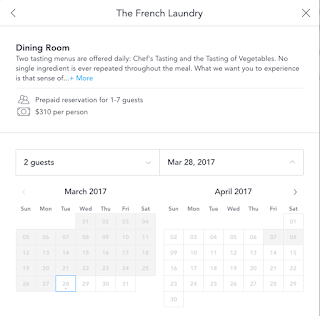
Initially, I think I accidentally tried to make a reservation on March 27 because I actually thought it was just the opening of the calendar month window interface. What I didn't see was that this was further down the screen.
 Instead, when I clicked the date, the calendar interface was gone. Same result, sort of, but up until this point, I thought I was making progress. So I clicked on "Add Me to the Wait List."

It was at this moment that I realized that things were unfolding badly for me. I went ahead and added my name to the wait list. At the same time, I was extremely frustrated that I couldn't add anything, no notes or comments, to clarify that this wasn't just any day, that it was my wife's birthday. Sure, I could add us to a wait list a week later, but that day wouldn't be anywhere nearly as important as the first day that I signed up for.
Since that time, I've also realized that there are other issues with the TockTix waiting line system.
Prospective Customers and The French Laundry
As a business, The French Laundry doesn't have to care about potential customers in the queue in the same way that some businesses do. As long as they have limited seats and a consistent parade of butts in the seats, and as long as they deliver a premium, desirable experience to them, they don't really need to care about the people in line. If I get frustrated or you get frustrated, who cares. It won't stop the guy behind you from happily filling a seat, given the opportunity. And maybe you're so frustrated that you write a review on Yelp, but you haven't even been there, so your complaints are hollow. In short, even if you say, "they suck," it's pretty unlikely that you're voice will be heard over the din of oohs and ahs from people who have been there. In the end, it doesn't matter. The French Laundry brand will transcend your unhappiness. They don't need you.
For me, this whole experience diminished the brand. Ultimately, that won't matter to you, the next guy in line, or probably anyone considering going to the restaurant.
And so you're probably thinking that, if they called me today and said, we've got a table for you and your wife, I would change my tune. To that, I'd say, you're probably right about going -- we still haven't canceled all of our Yountville plans yet. And at the same time, The French Laundry brand will never hold the same elevated benchmark status for me as it once did. And I think it's unlikely that I ever will go there. I certainly won't pursue reservations or try to get into the line again.
The French Laundry holds a special position of royalty in the food pantheon, one of those places we revere and, even as restaurant ratings change and prestige hops from one establishment to the next, it remains a benchmark for once-in-a-lifetime dining. We've never been there, but we've seen glimpses of the food in film and video, tasted approximations in dishes we made from the cookbook.
As one of the world's greatest restaurants, The French Laundry has always been difficult to get reservations at, and that's been true since well before the first time my wife and I went to Napa together in 2006 (before there was OpenTable and smart phones). And over the years, we've made a few casual attempts to get reservations, but never anything to concerted as the actual prospect of getting reservations, combined with a window of opportunity to go, seemed unlikely.
The Plan is Made
Once we decided that we would try to do The French Laundry for my wife's birthday dinner, I needed to prepare the support logistics. After an epic meal with wine pairings, nobody has any business driving, so you need to stay in close proximity to the restaurant, so I booked a hotel in Yountville. And, while the price for the hotel rooms seemed extremely high -- we even considered abandoning the Napa plan and heading for Hawaii -- we decided that it would be worth it. Additionally, since we were already going to be up there, it seemed worthwhile to book reservations at another restaurant on Friday night, the 28th. As we'd always wanted to try Redd (heard great things about it), that was the first place I checked -- and booked a reservation. Finally, my wife requested a couple's massage, so I tracked down a spa in Yountville for that -- and booked at the beginning of March. All that remained was to book our dinner at The French Laundry.
While I don't follow their site and I haven't ever successfully gotten a reservation there, I can say with some confidence that, for the longest time The French Laundry maintained a policy of taking reservations one month to the calendar date before the actual date -- as you'll note from this snapshot grabbed from the WayBack Machine.
While this was probably a windfall for some seeking reservations, if you were like me and last visited The French Laundry site on say, March 19, you didn't know anything about it. And, if you were like me, you sat, thinking you were in the non-existent virtual line waiting for the reservation day opening to appear. Perhaps I should have called. Pestered the staff at the restaurant. Ah, hindsight perhaps. But it wasn't until Sunday evening, March 26, when I decided to visit the site again, thinking I would check on the Open Table portal, that I discovered the new ticketing system... and that all of the reservation opportunities were now gone.
Perhaps, I thought, I'm just missing something. Perhaps if I call the restaurant in the morning at 10:00am (as the web site used to say), I can speak with a human. Perhaps they can help me understand what's happening. Maybe they have some tables set aside for something special like my wife's birthday. And, having spent the night wracked with unpleasant French Laundry dreams, I got up, went to work, and called The French Laundry at 10:00am. Of course, the number doesn't do anything now except take you to an electronic message detailing the new reservation system.
#FAIL -- Suprises in Queueing are a Recipe for Customer Frustration
You don't have to be an expert in queue theory to know that people in a queue don't like surprises. Imaging if the window for taking food orders has a long line and then, suddenly, that window closes and another window opens up on the other side of the building. Without careful line management, the odds are unlikely that the people who were nearest the front of the line will find themselves near the front of the line at the new window. And there will be much frustration.
But it doesn't have to be that way. With careful queue management, a business can exert control over the line, manage the changes, and maintain customer satisfaction (like the clerk who comes to get the next person in line). It's not difficult for a business to do this, it's just that customer satisfaction and customer experience must be a consideration for the business.
And that's why, as I wrote on Twitter, it's surprising that The French Laundry would be so haphazard with their roll-out of this new ticketing system. Surely, The French Laundry, the restaurant that lands the plates of diners with such precisely timed synchronization, would be the pinnacle of customer awareness. Sadly, it looks as though all of that careful attention to detail and customer experience only happens in the dining room. It certainly didn't carry over to the roll-out of this ticketing system.
Consider the timeline as I can backdate it from news and communication reports.
- March 19, 2017 -- @_TFL_ announces the new ticketing system on their Twitter feed
- March 20, 2017 -- Local news outlets, SFGate and NBC Bay Area pick up the story
- March 23, 2017 -- Wine Spectator does a piece on the new ticketing system
- March 24, 2017 -- Food and Wine piece notes all reservations through June 30 are booked
What's up with TockTix?
Fundamentally, the difference between the Open Table system and the TockTix system is that users must essentially purchase their spot at the restaurant -- their experience -- at the time of booking. The strategy behind this, from the restaurant's perspective, is to prevent no-shows.
When I first encountered the Tocktix system on Sunday night, March 26, I had a number of reactions. My initial reaction was, what happened to the old reservations screen? Initially, I thought that perhaps this was the result of the opening of a new window of bookings for April 27th, and I was excited to see a booking time/interface. Of course, that was not the case.
Here's an example (taken today) of the Tocktix interface.
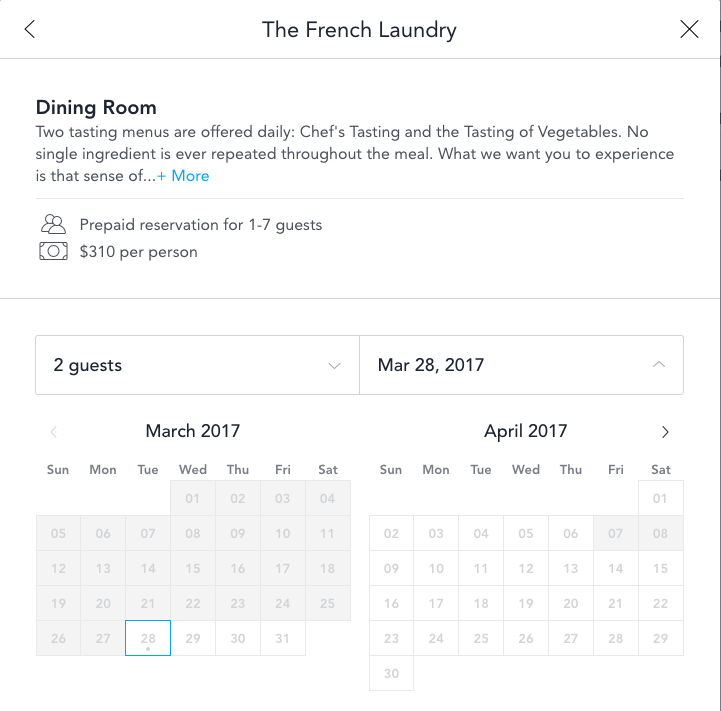
Initially, I think I accidentally tried to make a reservation on March 27 because I actually thought it was just the opening of the calendar month window interface. What I didn't see was that this was further down the screen.


It was at this moment that I realized that things were unfolding badly for me. I went ahead and added my name to the wait list. At the same time, I was extremely frustrated that I couldn't add anything, no notes or comments, to clarify that this wasn't just any day, that it was my wife's birthday. Sure, I could add us to a wait list a week later, but that day wouldn't be anywhere nearly as important as the first day that I signed up for.
Since that time, I've also realized that there are other issues with the TockTix waiting line system.
- I can't tell what position in line that I am.
- I can't drop my listing from the wait list, like if say, we decided to cancel the entire trip to Yountville and go somewhere else.
- I get no sense of movement or updates from the list. I don't even get an initial confirmation email confirming my place in line. What if all of the other "people" in front of me are ticketing bots?
Prospective Customers and The French Laundry
As a business, The French Laundry doesn't have to care about potential customers in the queue in the same way that some businesses do. As long as they have limited seats and a consistent parade of butts in the seats, and as long as they deliver a premium, desirable experience to them, they don't really need to care about the people in line. If I get frustrated or you get frustrated, who cares. It won't stop the guy behind you from happily filling a seat, given the opportunity. And maybe you're so frustrated that you write a review on Yelp, but you haven't even been there, so your complaints are hollow. In short, even if you say, "they suck," it's pretty unlikely that you're voice will be heard over the din of oohs and ahs from people who have been there. In the end, it doesn't matter. The French Laundry brand will transcend your unhappiness. They don't need you.
For me, this whole experience diminished the brand. Ultimately, that won't matter to you, the next guy in line, or probably anyone considering going to the restaurant.
And so you're probably thinking that, if they called me today and said, we've got a table for you and your wife, I would change my tune. To that, I'd say, you're probably right about going -- we still haven't canceled all of our Yountville plans yet. And at the same time, The French Laundry brand will never hold the same elevated benchmark status for me as it once did. And I think it's unlikely that I ever will go there. I certainly won't pursue reservations or try to get into the line again.
Tuesday, October 25, 2016
Salesforce.com Support: Is Quickly Not Helping Really Helpful?
So a funny thing happened on my way through a normal workday. Wearing my Salesforce.com Admin hat, I was contacted about a problem by one of our users. After guessing at the first answer -- what would be most logical -- then diving into it myself, I found myself mired in another one of those "this is something that people have been requesting from Salesforce for years and they haven't done anything" problems. That by itself would probably merit an annoyed blog post, but it's what happened after that that sent me straight to Blogger.
Let's start with a bit of background. Imagine you're in Salesforce and you're on a custom object page (I think this actually applies to standard objects, but I don't really want to explore the nuances of things that don't work). Let's say the object is a "Quote". Now you've just created this quote and you want to use Salesforce's email tool to send the Quote to your customer. But you don't want to send it just to Bob, your primary contact. You also need to send the quote to Sue in purchasing and maybe Alex in administration. Here's the screen that you'd see:
 From here, you'd enter Bob's contact information in the To: and Salesforce would link the email to his contact info (including using the email address from his record). But for Sue and Alex, you'd expect to use the Additional To or the CC fields. However, if you click on the Additional to link, what you'll be brought to is a window with this at the top:
 Now, what several online items suggest -- and you might expect to happen from "All Co-workers in Company" is any contacts on the Account linked to the Contact. However, what the list actually holds is all of the Users from your company. This happens from any of the search window buttons as well. Oh, and you might expect that the "Show" would let you choose from another list option. It doesn't.
If you want to add Sue or Alex, you have to type their email addresses into the Additional to or CC email windows. And if this is part of a process that you repeat frequently, you can expect to do a lot of typing.
But Wait, There's More...
This has been a problem in Salesforce for a long time. When I went looking for solutions on Google "Salesforce email additional to", I came across these outstanding ideas:
First, here are three Ideas covering the exact same issue, going all the way back six years ago.
https://success.salesforce.com/ideaView?id=08730000000Z2vmAAC
https://success.salesforce.com/ideaview?id=08730000000HARDAA4
https://success.salesforce.com/ideaView?id=08730000000jJn3AAE
Next, here is some misinformation in their help knowledgebase that incorrectly informs people of how the functionality is supposed to work:
https://help.salesforce.com/HTViewSolution?id=000180786&language=en_US
https://success.salesforce.com/answers?id=90630000000gtrnAAA
Are you frustrated yet? Discovering this, I went on Twitter to share my frustration with @asksalesforce. Usually, they're pretty responsive, and the got back to me quickly. They also created a case. And this is where it gets even funnier.
The Quick Customer Service Response You Didn't Really Want
So this afternoon I received a call from Salesforce Customer Support. The call came from slightly soft-spoken Indian woman calling from a rather noisy call center room. I mention this because, between her accent and the background room noise, it made it a bit challenging to understand a lot of what she was saying. Without much of an intro, she requested that I go to GoToMeeting.com. I explained that I was in the middle of a project and she repeated her request that I go to GoToMeeting.com so that she could see the issue.
Now, the security guy in me would normally be pretty wary, but I have to admit that I was finding this so ludicrous that I decided to play along. So I fire up GoToMeeting and she gives me the meeting ID. And, of course, when I open the meeting, it immediately wants to share my screen and access my mouse and keyboard. No introductions, no gentle ask to access my screen.
Anyway, so I turn on the screen share and she asks me to demonstrate the issue. So I take her to a record and show her. Then we discuss it briefly. I also show her the Ideas. Then she proceeds to confirm that this is standard functionality. Rather than me explain, here's from the case file:
In this case, Salesforce customer service was very quick in trying to help. Unfortunately, what they accomplished not only wasn't helpful, it actually annoyed me more than it did anything else. For example, they didn't even note that the ideas actually covered the same issue and, if combined, might reach their threshold for consideration. But beyond that, I could have told the Twitter team at @asksalesforce that this wasn't worth a case because I already knew they weren't going to do anything about it. I mean, the Idea Exchange shows that they've had six years to address it.
The whole thing reminds me that, several years ago I'd actually installed a component that would at least auto-complete email addresses in the Additional To field based on scanning the existing contact table. Unfortunately, like many free little add-ons over the years, I don't think that one works any longer.
So what's the take-away? While monitoring customer service channels like Twitter are great, it's probably not so great if you don't actually intend to fix the issue. For whatever reason, there are some functional issues -- like email sync that isn't using Microsoft Exchange -- that just don't rank highly (although they're supposedly close to fixing that for Gmail). Honestly, I'd be disappointed in Salesforce, but this is one of those where I really got what I expected -- I'm just no better off for having been there.
Let's start with a bit of background. Imagine you're in Salesforce and you're on a custom object page (I think this actually applies to standard objects, but I don't really want to explore the nuances of things that don't work). Let's say the object is a "Quote". Now you've just created this quote and you want to use Salesforce's email tool to send the Quote to your customer. But you don't want to send it just to Bob, your primary contact. You also need to send the quote to Sue in purchasing and maybe Alex in administration. Here's the screen that you'd see:


If you want to add Sue or Alex, you have to type their email addresses into the Additional to or CC email windows. And if this is part of a process that you repeat frequently, you can expect to do a lot of typing.
But Wait, There's More...
This has been a problem in Salesforce for a long time. When I went looking for solutions on Google "Salesforce email additional to", I came across these outstanding ideas:
First, here are three Ideas covering the exact same issue, going all the way back six years ago.
https://success.salesforce.com/ideaView?id=08730000000Z2vmAAC
https://success.salesforce.com/ideaview?id=08730000000HARDAA4
https://success.salesforce.com/ideaView?id=08730000000jJn3AAE
Next, here is some misinformation in their help knowledgebase that incorrectly informs people of how the functionality is supposed to work:
https://help.salesforce.com/HTViewSolution?id=000180786&language=en_US
https://success.salesforce.com/answers?id=90630000000gtrnAAA
Are you frustrated yet? Discovering this, I went on Twitter to share my frustration with @asksalesforce. Usually, they're pretty responsive, and the got back to me quickly. They also created a case. And this is where it gets even funnier.
The Quick Customer Service Response You Didn't Really Want
So this afternoon I received a call from Salesforce Customer Support. The call came from slightly soft-spoken Indian woman calling from a rather noisy call center room. I mention this because, between her accent and the background room noise, it made it a bit challenging to understand a lot of what she was saying. Without much of an intro, she requested that I go to GoToMeeting.com. I explained that I was in the middle of a project and she repeated her request that I go to GoToMeeting.com so that she could see the issue.
Now, the security guy in me would normally be pretty wary, but I have to admit that I was finding this so ludicrous that I decided to play along. So I fire up GoToMeeting and she gives me the meeting ID. And, of course, when I open the meeting, it immediately wants to share my screen and access my mouse and keyboard. No introductions, no gentle ask to access my screen.
Anyway, so I turn on the screen share and she asks me to demonstrate the issue. So I take her to a record and show her. Then we discuss it briefly. I also show her the Ideas. Then she proceeds to confirm that this is standard functionality. Rather than me explain, here's from the case file:
This is the standard functionality of salesforce and you also confirmed that you saw a couple ideas which were for the same issue. These ideas are under point threshold which means that they have been planned as a future roadmap and may be available in future releases.Needless to say, the call was a waste of both of our time. I told her she could close the case and I hung up.
In this case, Salesforce customer service was very quick in trying to help. Unfortunately, what they accomplished not only wasn't helpful, it actually annoyed me more than it did anything else. For example, they didn't even note that the ideas actually covered the same issue and, if combined, might reach their threshold for consideration. But beyond that, I could have told the Twitter team at @asksalesforce that this wasn't worth a case because I already knew they weren't going to do anything about it. I mean, the Idea Exchange shows that they've had six years to address it.
The whole thing reminds me that, several years ago I'd actually installed a component that would at least auto-complete email addresses in the Additional To field based on scanning the existing contact table. Unfortunately, like many free little add-ons over the years, I don't think that one works any longer.
So what's the take-away? While monitoring customer service channels like Twitter are great, it's probably not so great if you don't actually intend to fix the issue. For whatever reason, there are some functional issues -- like email sync that isn't using Microsoft Exchange -- that just don't rank highly (although they're supposedly close to fixing that for Gmail). Honestly, I'd be disappointed in Salesforce, but this is one of those where I really got what I expected -- I'm just no better off for having been there.
Wednesday, July 27, 2016
Comcast XFinity Provides Internet at Hotel California
So I'm getting ready to move and one of the things that I need to do is schedule to disconnect my Comcast Internet service. I've been putting this off because I already know from stories that I've read online that it's going to be a pain. But I figure, maybe if I don't have to talk to anyone, it will be less of a hassle.
So I go online and start looking through the web site. There are a lot of options on the Comcast web site, but canceling your service isn't a very easy one to find. Eventually, I switch to search. I found a page that says that there are three ways that you can disconnect your service:
Needless to say, when I first looked at this list -- and the lack of date -- I didn't see a form that matched my needs. So I got on Comcast Chat. In the past when I've been setting things up, they've always been quite helpful. And so, working with the customer service rep using their online chat, I tried to schedule my end of service date. However, she gave me three options. First, she informed me that she could lower my bill. I informed her that since I was moving, unless she was going to lower it to $0, that wouldn't be very helpful. My other two options were to use a web link or to speak with a Comcast rep over the phone. I chose the web link -- which returned me to the very same form. She also told me to put my date of disconnect in the comments section.
So I filled out the form. I chose "No XFINITY where I'm moving", and I expect a call in the next two business days. I also fully expect that the rep on the phone will want to know where I'm moving and try to validate that there's no service that he can't sell me at my new location because "You can check out any time you like, but you can never leave."
So I s
So I go online and start looking through the web site. There are a lot of options on the Comcast web site, but canceling your service isn't a very easy one to find. Eventually, I switch to search. I found a page that says that there are three ways that you can disconnect your service:
- Send them an email
- Visit a Comcast store
- Send them a letter in the mail
- No XFINITY where I'm moving
- Current service doesn't meet my needs
- I no longer want my XFINITY service
- I am an active duty service member
Needless to say, when I first looked at this list -- and the lack of date -- I didn't see a form that matched my needs. So I got on Comcast Chat. In the past when I've been setting things up, they've always been quite helpful. And so, working with the customer service rep using their online chat, I tried to schedule my end of service date. However, she gave me three options. First, she informed me that she could lower my bill. I informed her that since I was moving, unless she was going to lower it to $0, that wouldn't be very helpful. My other two options were to use a web link or to speak with a Comcast rep over the phone. I chose the web link -- which returned me to the very same form. She also told me to put my date of disconnect in the comments section.
So I filled out the form. I chose "No XFINITY where I'm moving", and I expect a call in the next two business days. I also fully expect that the rep on the phone will want to know where I'm moving and try to validate that there's no service that he can't sell me at my new location because "You can check out any time you like, but you can never leave."
So I s
Friday, July 22, 2016
Semicon Booths and the Diminishing Resource Customer Service Problem
If you've seen my Twitter feed, you probably saw my most recent round of disgruntled ranting about Semicon and the booth rebook process this year. While it's worth briefly talking about my issue with Semi and the way that they organized rebook this year, what I want to focus on is the inherent customer service problem -- what do you do to make your customer happy in an environment where you're dealing with diminishing resources?
First, lets revisit my Semicon rebook problem for some background. The first thing that you have to know is that Semicon West typically takes place annually in July at the Moscone Center in San Francisco. Historically, it has been the premier event for semiconductor equipment manufacturers and their suppliers to exhibit. Since about 2008 or 2009, the show has partnered with the Intersolar show to occupy Moscone South, North and West halls during the event. However, because there is a large construction project to upgrade the Moscone Convention Center, the South hall will be closed during next year's Semicon West. This means that, for a show that has often had many companies booking their space in the same basic location year after year, the playing field was being upended.
For 2017, the Semicon West show will be located in the Moscone North hall and in the first floor of West, while Intersolar will occupy the second and third floor of West. Now, here are a couple of caveats that may shape your perception of the problem. First, you must realize some things about the layout of the exhibit halls. There are three entrances into Moscone South; however, there is really one entrance for the North hall and call it 1.5 entrances to the West hall, so if you've been located near an entrance, the available options have declined significantly. What's more, depending on the location you were considering, many of the larger booths near the entrance in the North hall actually faced away from the entrance -- unlike many shows, the minimum size for an island booth at Semicon West is 20'x40'. Anything below that, and you're in a peninsula, so the direction you face is a consideration.
But there are some additional considerations as well. The Semi people informed us that registration would only be located in the West hall, so theoretically everyone who picked up a badge would go through West. Another factor that is often worth considering, traditionally Semi has segmented the show floor into "Wafer Processing" and "Test and Assembly". For 2017, they decided to scrap that -- they still collect the information from your company, but there is no segmentation on the show floor. So, if you're hoping to locate near similar businesses, there is no longer any guidance to direct you where to go. It's like offering customers products with no differentiation or segmentation.
As someone with an early selection, I watched as some of the most ideal North hall spaces were taken. Then when it came to my time to pick, I had a choice between some less than ideal North hall spaces or what could potentially be a much better spot in West. I opted for West, only to watch as more and more of the companies that we wanted to be around selected spots in the North hall. Increasingly, what it looked like was that I had selected a premium spot in a location that with much fewer related businesses. I could consider changing my selection, but that would have resulted in a worse selection that I would have had initially. So after complaining about it on Twitter for a while, I decided to go in and complain to the staff at rebook. And this brings us back to the diminishing resource customer service problem -- while the guy that I spoke to could talk to me for a while and try to sooth me and tell me that he expected that it would all work out, realistically, he had limited options to provide relief.
Like the Stubhub problem, if they cancel your transaction or for some other reason it doesn't go through, there is no guarantee that there is a comparable replacement for that. So what do you do?
In the case of Stubhub, they fixed the account problem and waived their fees on a replacement transaction. While that might not have worked for an event that was in high demand, it worked for mine. Airline overbooking is another example of this customer service issue. The airlines usually resolve it by things like offering vouchers as an incentive to people who want to volunteer to get off the flight. In the case of Semicon West, well, there is still a significant amount of time between now and next year's event, so things may change.
Do you wrestle with customer service and diminishing resources? How do you address this kind of issue?
First, lets revisit my Semicon rebook problem for some background. The first thing that you have to know is that Semicon West typically takes place annually in July at the Moscone Center in San Francisco. Historically, it has been the premier event for semiconductor equipment manufacturers and their suppliers to exhibit. Since about 2008 or 2009, the show has partnered with the Intersolar show to occupy Moscone South, North and West halls during the event. However, because there is a large construction project to upgrade the Moscone Convention Center, the South hall will be closed during next year's Semicon West. This means that, for a show that has often had many companies booking their space in the same basic location year after year, the playing field was being upended.
For 2017, the Semicon West show will be located in the Moscone North hall and in the first floor of West, while Intersolar will occupy the second and third floor of West. Now, here are a couple of caveats that may shape your perception of the problem. First, you must realize some things about the layout of the exhibit halls. There are three entrances into Moscone South; however, there is really one entrance for the North hall and call it 1.5 entrances to the West hall, so if you've been located near an entrance, the available options have declined significantly. What's more, depending on the location you were considering, many of the larger booths near the entrance in the North hall actually faced away from the entrance -- unlike many shows, the minimum size for an island booth at Semicon West is 20'x40'. Anything below that, and you're in a peninsula, so the direction you face is a consideration.
But there are some additional considerations as well. The Semi people informed us that registration would only be located in the West hall, so theoretically everyone who picked up a badge would go through West. Another factor that is often worth considering, traditionally Semi has segmented the show floor into "Wafer Processing" and "Test and Assembly". For 2017, they decided to scrap that -- they still collect the information from your company, but there is no segmentation on the show floor. So, if you're hoping to locate near similar businesses, there is no longer any guidance to direct you where to go. It's like offering customers products with no differentiation or segmentation.
As someone with an early selection, I watched as some of the most ideal North hall spaces were taken. Then when it came to my time to pick, I had a choice between some less than ideal North hall spaces or what could potentially be a much better spot in West. I opted for West, only to watch as more and more of the companies that we wanted to be around selected spots in the North hall. Increasingly, what it looked like was that I had selected a premium spot in a location that with much fewer related businesses. I could consider changing my selection, but that would have resulted in a worse selection that I would have had initially. So after complaining about it on Twitter for a while, I decided to go in and complain to the staff at rebook. And this brings us back to the diminishing resource customer service problem -- while the guy that I spoke to could talk to me for a while and try to sooth me and tell me that he expected that it would all work out, realistically, he had limited options to provide relief.
Like the Stubhub problem, if they cancel your transaction or for some other reason it doesn't go through, there is no guarantee that there is a comparable replacement for that. So what do you do?
In the case of Stubhub, they fixed the account problem and waived their fees on a replacement transaction. While that might not have worked for an event that was in high demand, it worked for mine. Airline overbooking is another example of this customer service issue. The airlines usually resolve it by things like offering vouchers as an incentive to people who want to volunteer to get off the flight. In the case of Semicon West, well, there is still a significant amount of time between now and next year's event, so things may change.
Do you wrestle with customer service and diminishing resources? How do you address this kind of issue?
Monday, June 27, 2016
Enterprise Rent-A-Car: Mistakes and Credits
So, I've written a lot about Enterprise Car Rental lately. Part of the reason why I took this up again was that, after my contact with Miami regional manager Jose, I expected to receive some sort of communication, either explaining the issue, something confirming that they had credited my account -- something.
Just to check, I went back and looked at my credit card statement and there was a charge of $-54.87 on my card from Enterprise on June 2. Since this charge was in the same date range as some of the hotels that I had stayed at during my trip, I thought that this was the disputed charge.
This morning, after more attempts to get a response from Enterprise customer service, I finally decided to call my credit card company in order to dispute the charge. The customer service agent at the card company informed my that the June 2 number was a credit of $54.87, and that the prior charge was in May for $54.89. Essentially, they had credited me back the entire charge. Or rather, the entire charge, less two cents. I told the agent that I was okay with the two cent charge and we had a chuckle and left it at that.
In some respects, I owe Enterprise Customer Service an apology. They did actually credit my account and respond. At the same time, considering the back and forth that we had -- and the number of times that I tried to follow up with them -- I'm surprised that they didn't email me some notice that they'd credited my account. It would have saved me a month of albeit misplaced frustrations and it would have saved them from the stuff that I posted online.
At this point, I'm unsure as to whether I will rent from Enterprise again. Prior to our trip to Miami, I was raving to everyone about the great rate that we had received from Enterprise. We were excited. I was an evangelist. Now, I just don't know.
Just to check, I went back and looked at my credit card statement and there was a charge of $-54.87 on my card from Enterprise on June 2. Since this charge was in the same date range as some of the hotels that I had stayed at during my trip, I thought that this was the disputed charge.
This morning, after more attempts to get a response from Enterprise customer service, I finally decided to call my credit card company in order to dispute the charge. The customer service agent at the card company informed my that the June 2 number was a credit of $54.87, and that the prior charge was in May for $54.89. Essentially, they had credited me back the entire charge. Or rather, the entire charge, less two cents. I told the agent that I was okay with the two cent charge and we had a chuckle and left it at that.
In some respects, I owe Enterprise Customer Service an apology. They did actually credit my account and respond. At the same time, considering the back and forth that we had -- and the number of times that I tried to follow up with them -- I'm surprised that they didn't email me some notice that they'd credited my account. It would have saved me a month of albeit misplaced frustrations and it would have saved them from the stuff that I posted online.
At this point, I'm unsure as to whether I will rent from Enterprise again. Prior to our trip to Miami, I was raving to everyone about the great rate that we had received from Enterprise. We were excited. I was an evangelist. Now, I just don't know.
Friday, June 24, 2016
Enterprise Car Rental: Customer Lip Service
As I wrote a couple of weeks ago, I was finally contacted by Enterprise Car Rental. Back at the beginning of June, I spent some time on the phone with Jose, who claimed to be a regional manager for Enterprise in the Miami region. Jose listened, he was apologetic, and he told me that he would take care of everything for me. He also asked for my home address, the implication being that he was going to send me something as a symbolic apology. I also asked for a complete postmortem in an email.
And so, I left it there, waiting to see what Enterprise would do, what their response was. And, as things happen, I was very busy over the next couple of weeks. But I didn't forget. A week or so ago, I even called Jose on the cell number that he provided me, and left a voice mail requesting follow-up.
Since we first spoke, however, I have not heard anything nor received anything. Enterprise still has not credited my card for the incorrect charges. In short, they haven't done anything.
Earlier this week, I tweeted multiple follow-ups to @enterprisecares. They told me that they would follow up with Miami. To date, I still haven't received any response.
As I mentioned on Twitter, Enterprise Car Rental has inspired me to add a new tag to my blog, Customer Lip Service. This is one of those when they say that they'll take care of you in an attempt to make you feel better, but don't actually follow up with any real action. Remember when Iomega customers actually had to sue the company (and win) in order to get support for their ZIP Drives?
If you're considering renting a car, you should seriously consider this customer experience horror story as a cautionary tale.
And so, I left it there, waiting to see what Enterprise would do, what their response was. And, as things happen, I was very busy over the next couple of weeks. But I didn't forget. A week or so ago, I even called Jose on the cell number that he provided me, and left a voice mail requesting follow-up.
Since we first spoke, however, I have not heard anything nor received anything. Enterprise still has not credited my card for the incorrect charges. In short, they haven't done anything.
Earlier this week, I tweeted multiple follow-ups to @enterprisecares. They told me that they would follow up with Miami. To date, I still haven't received any response.
As I mentioned on Twitter, Enterprise Car Rental has inspired me to add a new tag to my blog, Customer Lip Service. This is one of those when they say that they'll take care of you in an attempt to make you feel better, but don't actually follow up with any real action. Remember when Iomega customers actually had to sue the company (and win) in order to get support for their ZIP Drives?
If you're considering renting a car, you should seriously consider this customer experience horror story as a cautionary tale.
Salesforce.com Data Importer - Customer Support Stories
As I've written about previously, I've had lots of issues with Salesforce.com's new Data Importer tool. Recently, while importing a number of leads, I came across an issue that I wrote about on Twitter -- namely, that when you import records with the new tool, if you set "Record Type" in the interface, the import doesn't actually respect that setting, instead assigning the records to the default record type. If you're importing a lot of records, this can be a real pain in the ass.
And so I fired out a series of tweets. Salesforce.com's Twitter customer support replied back suggesting that I create a case. Sure enough, when I did, Salesforce customer support contacted me back and informed me that it was a known issue -- and how to subscribe to updates for when it would be fixed.
The workaround, he informed me, was to use the legacy Data Import tool. I didn't think that was still available, but he directed me to a link at the top of the "Import Leads" page. It's subtle, and it would be nice if they included a more prominent button in the interface, but the good news is that the old tool is still there. Until early 2017.
Helpful Customer Service -- When They Talk To You
Overall, discussing the issue on the phone with the customer support rep worked out well. Much better than some of the responses that I've received online in the past. My favorite is when the Salesforce.com Twitter customer support sent me a link to "How to Configure Your .CSV file" in response to my complaints about the new Data Importer.
While talking with the rep on the phone, I also took the time to complain about how the new Data Import engine forced you to add a "Lead Status" field when you imported leads. His explanation is that the legacy tool didn't bother to verify whether required fields were populated or not and that, technically, the new tool works better. From an engineering perspective, I understand that this is a technically valid point. However, as I mentioned during my call, if you're importing LEADS, it's reasonable to assume that they are "OPEN". If not, you could easily add a Lead Status Field and import them with a different status. While it is technically operating closer to defined rules, it's not operating smarter.
We even spent a bit of time arguing about whether the Data Import Wizard would allow you to continue through your import if you left some fields unmapped. He adamantly swore that it would. My experience tells me that it doesn't. But your mileage may very.
Perhaps my biggest take-away from the experience is a reminder of just how much better it is to actually talk to a customer support person at Salesforce. It's a reminder that that aspect worked much better in the past, when they did more to support their customers before the days of expensive tiered customer support and the need to spend a ton of money just to access the human infrastructure.
And so I fired out a series of tweets. Salesforce.com's Twitter customer support replied back suggesting that I create a case. Sure enough, when I did, Salesforce customer support contacted me back and informed me that it was a known issue -- and how to subscribe to updates for when it would be fixed.
The workaround, he informed me, was to use the legacy Data Import tool. I didn't think that was still available, but he directed me to a link at the top of the "Import Leads" page. It's subtle, and it would be nice if they included a more prominent button in the interface, but the good news is that the old tool is still there. Until early 2017.
Helpful Customer Service -- When They Talk To You
Overall, discussing the issue on the phone with the customer support rep worked out well. Much better than some of the responses that I've received online in the past. My favorite is when the Salesforce.com Twitter customer support sent me a link to "How to Configure Your .CSV file" in response to my complaints about the new Data Importer.
While talking with the rep on the phone, I also took the time to complain about how the new Data Import engine forced you to add a "Lead Status" field when you imported leads. His explanation is that the legacy tool didn't bother to verify whether required fields were populated or not and that, technically, the new tool works better. From an engineering perspective, I understand that this is a technically valid point. However, as I mentioned during my call, if you're importing LEADS, it's reasonable to assume that they are "OPEN". If not, you could easily add a Lead Status Field and import them with a different status. While it is technically operating closer to defined rules, it's not operating smarter.
We even spent a bit of time arguing about whether the Data Import Wizard would allow you to continue through your import if you left some fields unmapped. He adamantly swore that it would. My experience tells me that it doesn't. But your mileage may very.
Perhaps my biggest take-away from the experience is a reminder of just how much better it is to actually talk to a customer support person at Salesforce. It's a reminder that that aspect worked much better in the past, when they did more to support their customers before the days of expensive tiered customer support and the need to spend a ton of money just to access the human infrastructure.
Thursday, June 2, 2016
Enterprise Car Rental Update: Contact.
So yesterday afternoon I received a call from a regional manager for Enterprise Car Rental in Miami. We discussed the issues that I had experienced and he apologized. He said that they would credit me back the incorrect charges. I asked for a more complete postmortem. I'll let you know when I have more.
Wednesday, June 1, 2016
Enterprise Car Rental Update: Still No Response. No Escalation?
So it's been over a week since I first raised this issue with Enterprise customer service through @Enterprise and @Enterprisecares on Twitter. On Monday night, I was informed by one customer service agent that they had created a case. On Friday morning, I was informed that my case was submitted a second time.
When you're setting up Salesforce.com, the default length of time for case escalation is 3 days. While I don't recall whether there was a default escalation schedule in Zendesk, there is no question that customer service CRM tools all recognize the importance of operating in a timely fashion.
For those that might not be familiar with it, case escalation essentially raises the importance of a case. When you first contact customer service at an organization using a customer service CRM, they typically create a case to track your issue. All of your communications with the company go there. There's also a status tracker that references what stage in the process of solving your problem the issue is in. Most cases are working toward a process stage of Closed - Solved. This is the customer service equivalent of a Sales Opportunity being Closed - Won.
This is why when you deal with some customer service organizations, they will specifically say something like, "Have I answered all of your questions" or "Is there anything else", followed by a "then can I mark this issue as closed" or something to that effect.
Escalation is the process where certain cases trigger automatic alerts, typically to managers who are supposed to have the oversight to step in and make sure certain kinds of issues don't get out of hand. Since many customer service contacts can be for fairly minor things, good customer service organizations use these tools to help prevent issues "falling through the cracks". The last thing you need is to contact Comcast for help setting up your cable, only to have them forget about you for a month. These are the kinds of things that alienate customers.
Customer service queuing is why customer service software is often used to send out status updates. It's a whole lot easier for you to feel like you're being taken care of when somebody informs you of their progress along the way. Imagine if you went to the customer service department in a store and the clerk listened to your story, said "I'll be back," and disappeared. How long would you wait before becoming frustrated? One hour? Less? Would you wait through the end of the day? Would you come back the next day?
So when you see things like my issue with Enterprise Car Rental, as you watch their customer service act and respond, you can't help but compare many of these actions to industry standard practices. These practices are not unknown. And when I asked their customer service about them over Twitter, they confirmed several aspects of them. This is not some 'Mom-n-Pop' organization. So where's the sense of progress? Where are my status updates? Where's my escalation?
And while it may seem crazy to be this dogged about something as minor as a $30 overcharge, it's important to remember -- this is the same customer service mechanism that you would deal with if something far worse had happened. For example, what if they were claiming damage to the vehicle or that, despite turning the vehicle in at an Enterprise Rental Car return, that they hadn't received the car and that it was missing? All of the gloss and friendliness at the front end of the rental counter doesn't mean anything if the customer service back-end sucks.
When you're setting up Salesforce.com, the default length of time for case escalation is 3 days. While I don't recall whether there was a default escalation schedule in Zendesk, there is no question that customer service CRM tools all recognize the importance of operating in a timely fashion.
For those that might not be familiar with it, case escalation essentially raises the importance of a case. When you first contact customer service at an organization using a customer service CRM, they typically create a case to track your issue. All of your communications with the company go there. There's also a status tracker that references what stage in the process of solving your problem the issue is in. Most cases are working toward a process stage of Closed - Solved. This is the customer service equivalent of a Sales Opportunity being Closed - Won.
This is why when you deal with some customer service organizations, they will specifically say something like, "Have I answered all of your questions" or "Is there anything else", followed by a "then can I mark this issue as closed" or something to that effect.
Escalation is the process where certain cases trigger automatic alerts, typically to managers who are supposed to have the oversight to step in and make sure certain kinds of issues don't get out of hand. Since many customer service contacts can be for fairly minor things, good customer service organizations use these tools to help prevent issues "falling through the cracks". The last thing you need is to contact Comcast for help setting up your cable, only to have them forget about you for a month. These are the kinds of things that alienate customers.
Customer service queuing is why customer service software is often used to send out status updates. It's a whole lot easier for you to feel like you're being taken care of when somebody informs you of their progress along the way. Imagine if you went to the customer service department in a store and the clerk listened to your story, said "I'll be back," and disappeared. How long would you wait before becoming frustrated? One hour? Less? Would you wait through the end of the day? Would you come back the next day?
So when you see things like my issue with Enterprise Car Rental, as you watch their customer service act and respond, you can't help but compare many of these actions to industry standard practices. These practices are not unknown. And when I asked their customer service about them over Twitter, they confirmed several aspects of them. This is not some 'Mom-n-Pop' organization. So where's the sense of progress? Where are my status updates? Where's my escalation?
And while it may seem crazy to be this dogged about something as minor as a $30 overcharge, it's important to remember -- this is the same customer service mechanism that you would deal with if something far worse had happened. For example, what if they were claiming damage to the vehicle or that, despite turning the vehicle in at an Enterprise Rental Car return, that they hadn't received the car and that it was missing? All of the gloss and friendliness at the front end of the rental counter doesn't mean anything if the customer service back-end sucks.
Friday, May 27, 2016
My Weird Bad Experience With Enterprise Car Rental
So I just wrapped up a busy two weeks of travel, mostly business, but some vacation. Travel seems to bring out lots of terrible customer service experiences. There are probably a number of reasons for this. When you're at home, you have routines and you probably frequent known businesses that deliver a predictable level of service. When you travel, you're probably dealing with new places, new businesses and your dealing with reviews, reputations and brands that you hope can ensure that you have quality experiences.
In many ways, this is where brands are supposed to thrive. If you're at home in the bay area, you can count on Philz, Peets, or Blue Bottle for quality coffee, but when you're in a town that you don't know, if there is a Starbucks, at least you can count on getting coffee that doesn't suck. Brands are brands because the commit to ensure a level of service and quality -- or that's the theory.
My Crazy, You-Don't-Want-This-to-Happen-to-You Enterprise Car Rental Experience
I've rented from Enterprise Car Rental many times over the years, probably back as far as the early 1990s. While my business travel has had me renting from many companies, I often found myself gravitating back to Enterprise for the lower prices, car offerings, and sometimes they even used to pick you up. One of the things that I was always disappointed with them for was that, for many years, I don't think they had a loyalty program. Several years ago, I finally found their loyalty program and signed up. With many of these things, I never wind up actually using the points, but often the business treats you a bit better because you're signed up.
So anyway, last week was Miami, with a long drive up Florida to visit Jacksonville with my wife. My wife's corporate rate with Avis is really good, so we were surprised when I got a car rental rate that was WAY lower from Enterprise. Enterprise was offering an $7.95 per day rental for a pick-up in Miami and drop off in Jacksonville. My three day rental with unlimited mileage was under $25. Whenever I told anyone how much I was quoted, they were also shocked. It was one of those rates that made me happy -- thrilled -- to be renting from Enterprise.
So we picked up the car on Thursday. It was the usual process of attempting to upsell me on insurance and Florida tolls, but other than that, nothing different from any other car rental that I've ever done. Then the quick inspection, and we were off in a nice new Toyota RAV4. Leaving the Miami metro area, I was halfway kicking myself about not spending the extra $4 for the automated toll coverage so I could escape a little bit of the traffic on I-95, but other than that, it was a pretty uneventful drive.
Fast forward to Saturday morning where we dropped off the car with way more gas than we needed to (only needed half a tank, but the RAV4 gas tank is actually kind of small). Through the usual drop off line at the airport, then the attendant asks if I'd like a copy of the receipt. I said yes, at which point she told me I needed to go the attendant in the Enterprise office there -- something we didn't really want to do since we were anxious to get through security and be ready for our flight. Thinking that it wouldn't be a problem -- I've had car rental receipts emailed to me on many occasions -- I asked if she could email the receipt and she said yet.
Two days later, Monday, May 23 at 6pm I finally received my receipt. The receipt claimed that I had had the car until nearly 2:00pm that Monday, putting me in a five day rental at $55. It goes without saying that my wife and I, having dropped the car at the airport, had been in New Orleans since Saturday, so the idea that I was being charged for two days that I didn't use the car was, in a word, bullshit.
Now, if you aren't really too worried about it, you might think that $55 was a reasonable amount to pay to drive a rental car from Miami to Jacksonville. You might be willing to let the $30 delta slide. But the problem that I have is that we did nothing different that we haven't done 100 times, with Enterprise and other rental car companies. It was standard operating procedure. And so the idea that for some unexplained reason, Enterprise would change the rules this time and surprise me with an unwarranted charge -- I really needed to get an explanation.
Enterprise Customer Service SUCKS
So I called Enterprise Customer Service using the toll free contact number published on their web site. After receiving my confirmation number, the customer service rep told me that there was nothing he could do and that I would have to call the Miami office where I rented the vehicle once they were open (on East Coast Time). He didn't seem to have any ability to log a case, couldn't provide me with a case number, and didn't seem to be willing to do anything other than essentially say, "man, that's a bummer. I'm sorry your frustrated. I can't do anything."
At this point, my frustration had amplified, so I got on Twitter and began telling my story, curious to see if Enterprise Car Rental monitored Twitter. About a half an hour after I started posting comments on Twitter to @enterprise and @enterprisecares, I finally received response with a request to send their customer service my confirmation number. After some back and forth with Enterprise customer service through Twitter direct messages, I was informed that "I sent your comments and concerns, and your contact information, to the Miami regional office for review and response. A manager will contact you as soon as possible," and a reference number was assigned.
Three days later, and I still haven't heard anything from Enterprise Car Rental. As soon as possible doesn't seem to mean what you might think it means. At this point, I'm left feeling like Enterprise Car Rental is trying to rip me off -- and the ironic part is that it's for about $30. Keep in mind that I'm a points-holding member of their loyalty program who, before having this billing dispute, would have likely been a huge recommender for Enterprise Car Rental. Now, I question whether they're going pull some crazy shit when you turn your car in. And I most certainly would get a receipt before I leave!
As I mentioned on Twitter, "this is the critical interrelationship between customer service and marketing." Right now, I'm questioning my entire relationship with Enterprise Car Rental. That affects not just one location in one state, but other locations and other potential business. In one customer service moment, Enterprise could have looked at this and said, "hah, some crazy clerical error, clearly not worth the $30 to even argue it." But instead, they send me into some shitstorm of a bureaucratic devil's triangle, where the issue just seems to get lost. @enterprisecares. Except they forgot to close the <satire> tag.
How do you think things like this promotional email from Enterprise will work with me going forward?
This, my friends, seriously deserves a #FAIL tag.
In many ways, this is where brands are supposed to thrive. If you're at home in the bay area, you can count on Philz, Peets, or Blue Bottle for quality coffee, but when you're in a town that you don't know, if there is a Starbucks, at least you can count on getting coffee that doesn't suck. Brands are brands because the commit to ensure a level of service and quality -- or that's the theory.
My Crazy, You-Don't-Want-This-to-Happen-to-You Enterprise Car Rental Experience
I've rented from Enterprise Car Rental many times over the years, probably back as far as the early 1990s. While my business travel has had me renting from many companies, I often found myself gravitating back to Enterprise for the lower prices, car offerings, and sometimes they even used to pick you up. One of the things that I was always disappointed with them for was that, for many years, I don't think they had a loyalty program. Several years ago, I finally found their loyalty program and signed up. With many of these things, I never wind up actually using the points, but often the business treats you a bit better because you're signed up.
So anyway, last week was Miami, with a long drive up Florida to visit Jacksonville with my wife. My wife's corporate rate with Avis is really good, so we were surprised when I got a car rental rate that was WAY lower from Enterprise. Enterprise was offering an $7.95 per day rental for a pick-up in Miami and drop off in Jacksonville. My three day rental with unlimited mileage was under $25. Whenever I told anyone how much I was quoted, they were also shocked. It was one of those rates that made me happy -- thrilled -- to be renting from Enterprise.
So we picked up the car on Thursday. It was the usual process of attempting to upsell me on insurance and Florida tolls, but other than that, nothing different from any other car rental that I've ever done. Then the quick inspection, and we were off in a nice new Toyota RAV4. Leaving the Miami metro area, I was halfway kicking myself about not spending the extra $4 for the automated toll coverage so I could escape a little bit of the traffic on I-95, but other than that, it was a pretty uneventful drive.
Fast forward to Saturday morning where we dropped off the car with way more gas than we needed to (only needed half a tank, but the RAV4 gas tank is actually kind of small). Through the usual drop off line at the airport, then the attendant asks if I'd like a copy of the receipt. I said yes, at which point she told me I needed to go the attendant in the Enterprise office there -- something we didn't really want to do since we were anxious to get through security and be ready for our flight. Thinking that it wouldn't be a problem -- I've had car rental receipts emailed to me on many occasions -- I asked if she could email the receipt and she said yet.
Two days later, Monday, May 23 at 6pm I finally received my receipt. The receipt claimed that I had had the car until nearly 2:00pm that Monday, putting me in a five day rental at $55. It goes without saying that my wife and I, having dropped the car at the airport, had been in New Orleans since Saturday, so the idea that I was being charged for two days that I didn't use the car was, in a word, bullshit.
Now, if you aren't really too worried about it, you might think that $55 was a reasonable amount to pay to drive a rental car from Miami to Jacksonville. You might be willing to let the $30 delta slide. But the problem that I have is that we did nothing different that we haven't done 100 times, with Enterprise and other rental car companies. It was standard operating procedure. And so the idea that for some unexplained reason, Enterprise would change the rules this time and surprise me with an unwarranted charge -- I really needed to get an explanation.
Enterprise Customer Service SUCKS
So I called Enterprise Customer Service using the toll free contact number published on their web site. After receiving my confirmation number, the customer service rep told me that there was nothing he could do and that I would have to call the Miami office where I rented the vehicle once they were open (on East Coast Time). He didn't seem to have any ability to log a case, couldn't provide me with a case number, and didn't seem to be willing to do anything other than essentially say, "man, that's a bummer. I'm sorry your frustrated. I can't do anything."
At this point, my frustration had amplified, so I got on Twitter and began telling my story, curious to see if Enterprise Car Rental monitored Twitter. About a half an hour after I started posting comments on Twitter to @enterprise and @enterprisecares, I finally received response with a request to send their customer service my confirmation number. After some back and forth with Enterprise customer service through Twitter direct messages, I was informed that "I sent your comments and concerns, and your contact information, to the Miami regional office for review and response. A manager will contact you as soon as possible," and a reference number was assigned.
Three days later, and I still haven't heard anything from Enterprise Car Rental. As soon as possible doesn't seem to mean what you might think it means. At this point, I'm left feeling like Enterprise Car Rental is trying to rip me off -- and the ironic part is that it's for about $30. Keep in mind that I'm a points-holding member of their loyalty program who, before having this billing dispute, would have likely been a huge recommender for Enterprise Car Rental. Now, I question whether they're going pull some crazy shit when you turn your car in. And I most certainly would get a receipt before I leave!
As I mentioned on Twitter, "this is the critical interrelationship between customer service and marketing." Right now, I'm questioning my entire relationship with Enterprise Car Rental. That affects not just one location in one state, but other locations and other potential business. In one customer service moment, Enterprise could have looked at this and said, "hah, some crazy clerical error, clearly not worth the $30 to even argue it." But instead, they send me into some shitstorm of a bureaucratic devil's triangle, where the issue just seems to get lost. @enterprisecares. Except they forgot to close the <satire> tag.
How do you think things like this promotional email from Enterprise will work with me going forward?
DRIVE AWAY WITH SAVINGS AND POINTSAs a business, how much do you think Enterprise's marketing group is spending on ExactTarget for email marketing? And then, to watch that spend get kneecapped by their customer service? It's got to be frustrating. After all, could any number of "We miss you" emails overcome one bad customer service experience? From the marketing end of the business, all we can say is unbelievable. For about $30. It really sounds like a joke doesn't it.
Save 20%.
We miss you. Come back and save 20% at participating locations. You can earn valuable points toward free rental days.
This, my friends, seriously deserves a #FAIL tag.
Wednesday, May 18, 2016
Uber, Lyft, and Various Customer Experience Frustrations
So I've been busy with a lot of business travel and this week found me in downtown Miami. Over the week, I've had several experiences with both Uber and Lyft, including some bad ones that you'll see on my Twitter feed, but I thought it was a good time to share a few observations.
First, on Uber versus Lyft -- this has been mixed. Over the past several months, we've tried to use Lyft more. For one reason, when we spoke to the drivers, most -- particularly those that drive for both services -- tell us that Lyft is better for them. They say that the company is nicer and that Lyft pays them better. However, there is not always as many opportunities on Lyft, so many drivers find themselves drawn to the Uber side for that reason.
Similarly, we were told that here in Miami, Uber had recently run something like a week of a "$3.05" special, where all rides under a certain distance were only $3.05 -- great for riders but terrible for drivers.
Then earlier today I had my bigger mess. First, I tried to order a Lyft ride and the driver came close to where I was, apparently clicked the indicator that he was here, then proceeded to drive to the destination that I had entered into the app. In the process of watching this and trying to figure out what was going on, I tried texting the driver, to no avail, and then calling. The person who answered acted spoke with a heavy Latin accent and almost seemed to act as though I had called the wrong number. One important observation on this experience -- if you're in the theoretical ride, there is no cancellation button. I would have liked a WTF button myself. What happens if something is going wrong with the ride? Wouldn't it be good to have some way of alerting the ridesharing service?
Eventually, my not-ride ended and freed up the app, but not before I'd switched over and requested a ride from Uber. This one drove up, but also seemed to have the wrong pick-up location. When I called the driver to let them know where we were, again, "no speak Spanish" was repeated several times followed with nothing audibly coherent beyond that. Since this driver hadn't "picked me up", I cancelled. The next thing I know, I received a receipt from Uber for a $5.00 cancellation fee.
Each company's customer service practices differed as well. With Lyft, my Twitter posts (and perhaps my accessing the help function in their app), triggered them to look at the charge, refund it, and even offer me a credit on a future ride. In contrast, Uber hardly responded to my Twitter complaints and, when they did, suggested that I go through their site to question the charge. Too busy I suppose.
Don't get me wrong, since most of these Lyft rides are business related items that will just go on my expense report, credits and discounted rides are not really a big incentive to continue to use the service, but I understand what they're trying to do and, practically there's a limit on what tools are available to a business in customer service issues like this.
Overall, while I've mostly been happy with my Lyft experiences, I've hit several times when Lyft has popped a warning screen that higher rates were in effect -- something that usually deters me from requesting a ride with them -- only for me to switch to the Uber app and see no rate increase in effect. Don't get me wrong, if I get an alert from Uber that there is surge pricing in effect, I refuse to use the service. I am very much against these rate multipliers. Given a rate multiplier, I will quickly switch to a cab, period, end of story.
Perhaps the worst thing was, after you've had a bad experience with both the rideshare companies, you start to wonder what will the result be if you book your return trip from the destination with them. In several locations I've gotten the same driver before, what happens if it's the same driver or drivers again? This is the kind of thing that nags at you and, frankly, I'm not sure that credits really answer.
First, on Uber versus Lyft -- this has been mixed. Over the past several months, we've tried to use Lyft more. For one reason, when we spoke to the drivers, most -- particularly those that drive for both services -- tell us that Lyft is better for them. They say that the company is nicer and that Lyft pays them better. However, there is not always as many opportunities on Lyft, so many drivers find themselves drawn to the Uber side for that reason.
Similarly, we were told that here in Miami, Uber had recently run something like a week of a "$3.05" special, where all rides under a certain distance were only $3.05 -- great for riders but terrible for drivers.
Then earlier today I had my bigger mess. First, I tried to order a Lyft ride and the driver came close to where I was, apparently clicked the indicator that he was here, then proceeded to drive to the destination that I had entered into the app. In the process of watching this and trying to figure out what was going on, I tried texting the driver, to no avail, and then calling. The person who answered acted spoke with a heavy Latin accent and almost seemed to act as though I had called the wrong number. One important observation on this experience -- if you're in the theoretical ride, there is no cancellation button. I would have liked a WTF button myself. What happens if something is going wrong with the ride? Wouldn't it be good to have some way of alerting the ridesharing service?
Eventually, my not-ride ended and freed up the app, but not before I'd switched over and requested a ride from Uber. This one drove up, but also seemed to have the wrong pick-up location. When I called the driver to let them know where we were, again, "no speak Spanish" was repeated several times followed with nothing audibly coherent beyond that. Since this driver hadn't "picked me up", I cancelled. The next thing I know, I received a receipt from Uber for a $5.00 cancellation fee.
Each company's customer service practices differed as well. With Lyft, my Twitter posts (and perhaps my accessing the help function in their app), triggered them to look at the charge, refund it, and even offer me a credit on a future ride. In contrast, Uber hardly responded to my Twitter complaints and, when they did, suggested that I go through their site to question the charge. Too busy I suppose.
Don't get me wrong, since most of these Lyft rides are business related items that will just go on my expense report, credits and discounted rides are not really a big incentive to continue to use the service, but I understand what they're trying to do and, practically there's a limit on what tools are available to a business in customer service issues like this.
Overall, while I've mostly been happy with my Lyft experiences, I've hit several times when Lyft has popped a warning screen that higher rates were in effect -- something that usually deters me from requesting a ride with them -- only for me to switch to the Uber app and see no rate increase in effect. Don't get me wrong, if I get an alert from Uber that there is surge pricing in effect, I refuse to use the service. I am very much against these rate multipliers. Given a rate multiplier, I will quickly switch to a cab, period, end of story.
Perhaps the worst thing was, after you've had a bad experience with both the rideshare companies, you start to wonder what will the result be if you book your return trip from the destination with them. In several locations I've gotten the same driver before, what happens if it's the same driver or drivers again? This is the kind of thing that nags at you and, frankly, I'm not sure that credits really answer.
Monday, May 9, 2016
When Southwest Airlines Queueing System Fails
About a year ago, I wrote another blog post about Southwest Airlines and some of their frustrating business practices. As I mentioned in the post, "Southwest Airlines is a great example of one of those love-hate relationships that just make you crazy." This morning found me on the hate end of the spectrum once again.
As you might have seen from my Twitter feed, I'm gearing up for about two weeks of travel. My trip includes about five cities and some cross country travel. Normally, for cross-country travel, I've found that I prefer JetBlue as their planes provide a human amount of leg room, but unfortunately, several of the cities that I need to visit aren't served by JetBlue. What's more, to book a trip like this on United or American would have been difficult -- and priced out at a couple thousand dollars, more than double the cost of Southwest. While I usually try to avoid Southwest Airlines for cross country flights, this trip was pretty much impossible without choosing them.
In fact, my trip was so complicated that our existing corporate travel software couldn't book it. I have so many legs on this trip, I needed to contact our travel agent and have them book it. And this is what kicked off my latest frustration with Southwest Airlines.
It turns out that, unbeknownst to me, the travel agent didn't put my birth date into one of the reservations. This is required information for you to obtain a boarding pass. Now, in a world of reserved seats, leaving out information like this is not the biggest problem -- you most likely have a specific seat booked. However, Southwest Airlines with it's "check-in 24 hours before your flight to obtain your place in line for boarding", errors and delays with check-ins can be a significantly greater problem. In my case, it turned into errors trying to check-in on both the Southwest App and their web site, followed by a call to their customer service (and a long hold time), all the while "critical" seconds were ticking away, moving me farther and farther back in the check in line. And at the end of the experience, what did I get? Essentially, the equivalent of Southwest Airlines saying, "Bummer man, I hope you enjoy the rest of your trip."
Set Up For Customer Service Failure: The Southwest Queuing System
In the old days, Southwest Airlines numbered boarding line made sense. You'd arrive at the airport, check-in, and they'd give you a little plastic boarding tag. If you wanted a low A boarding number, you showed up to the airport early. It also meant that usually the first people on the plane were those skittish travelers who arrived at the airport two hours early for a domestic flight. Of course, it sucked for business because if you arrived at the airport at the last minute, you were trying to cram your carry-on in around Aunt Susie and Uncle Pete's haphazardly placed bags in the overhead. It sucked so bad that Southwest created their Business Select that automatically gave you an A1-15 boarding pass -- for a premium "business" price.
With the advent of online check-ins, Southwest set up a system where you could check in and get your number 24 hours in advance of your flight. At times, I've wondered why it seems like many of the same "traveling on vacation" people are ahead of me in the line. I suspect that the same thing that made Aunt Susie and Uncle Pete show up two hours in advance for that flight is the same thing that has them sitting around by the computer on the weekend waiting for the time to tick over -- for them, it's a big vacation, but for me it's the Sunday before a business trip.
The other irony is that several people have built apps to automatically check you into your Southwest flight, although Southwest has apparently been very aggressive at sending cease and desist orders to stop web sites that enabled you to automatically check you in. Why? Southwest charges $15 to let you automatically check-in as soon as you can. You can still find some coding tools to automate your browser - let's be honest, scripting an activity like this to take place isn't that hard - but Southwest is bound and determined to monetize this part of the transaction.
So let's talk about all the failure points that happened during my transaction and how Southwest could have improved the process.
1. Travel agent books the flight. Provides incomplete information. Shouldn't the system validate the information and determine if all information was provided? Shouldn't it prevent saving a record if essential information is missing? This is like web application 101.
2. Once the flight was booked (a couple of weeks ago), there was no follow up. Nowhere in the flight information does it indicate that incomplete information was provided. Considering that I'm signed up on their RapidRewards program and my flights were linked to my RapidRewards account, you'd think that they could have sent an automated email saying "complete your flight information in order to streamline your check-in process." As it turns out, there was other information missing from my reservation as well. Why can't you see this information in the Southwest App?
3. Checking In. When I tried to check in, the error message in the app said, "Parameter value is missing. Error 400500134 (Flvu9-BDQFi1L9WKitm9Vw-API)". In hindsight, I can kind of put together something about what the error means, but at the time it was unclear what the problem was. Even better was when I tried to check in through the Southwest Airlines web site. Here's the screen:
 Gotta love "Reference Code: 999999999".
So yes, these error messages suck. But what sucks worse is that they potentially leave you with the impression that there is some larger system error at play and to simply keep trying. Keep trying while the sand ticks out of the hour glass and more and more people check in ahead of you.
4. I call Southwest. Automated phone navigation system. Long wait times. These are things I would expect. The Southwest customer service agent was friendly and helpful. She updated my information and checked me in. When all is said and done, I wound up with a number in the upper B boarding.
But here's the problem. Through no fault of mine, I've had a frustrating customer experience with you, Southwest Airlines, driven entirely by your "check-in for your place in line" business practice. You have created a situation where you're managing customer experience on a resource that potentially diminishes in value as time goes on. It's similar to the customer service issue with Stubhub -- if they cancel a transaction, that ticket you ordered is possibly gone and your opportunity may be gone. Whatever number I could have had if your check-in process had worked correctly is gone.
Now, as a customer service organization and a business, what are you going to do about that? As an example, Stubhub waived their transaction fees for our transaction. While that might not have helped if the tickets had been particularly limited, it was at least a gesture on their part to make things better within the scope of things that they could do. Stubhub did good customer service to address a frustrating customer experience.
What did Southwest Airlines do? Essentially said, "bummer man". Did they offer a number from the high A-list usually blocked out for business travel? No. Did they offer me some sort of credit (essentially meaningless on a business fare)? No. Did they even offer me drink tickets or something like that? No. Bummer man.
As you might have seen from my Twitter feed, I'm gearing up for about two weeks of travel. My trip includes about five cities and some cross country travel. Normally, for cross-country travel, I've found that I prefer JetBlue as their planes provide a human amount of leg room, but unfortunately, several of the cities that I need to visit aren't served by JetBlue. What's more, to book a trip like this on United or American would have been difficult -- and priced out at a couple thousand dollars, more than double the cost of Southwest. While I usually try to avoid Southwest Airlines for cross country flights, this trip was pretty much impossible without choosing them.
In fact, my trip was so complicated that our existing corporate travel software couldn't book it. I have so many legs on this trip, I needed to contact our travel agent and have them book it. And this is what kicked off my latest frustration with Southwest Airlines.
It turns out that, unbeknownst to me, the travel agent didn't put my birth date into one of the reservations. This is required information for you to obtain a boarding pass. Now, in a world of reserved seats, leaving out information like this is not the biggest problem -- you most likely have a specific seat booked. However, Southwest Airlines with it's "check-in 24 hours before your flight to obtain your place in line for boarding", errors and delays with check-ins can be a significantly greater problem. In my case, it turned into errors trying to check-in on both the Southwest App and their web site, followed by a call to their customer service (and a long hold time), all the while "critical" seconds were ticking away, moving me farther and farther back in the check in line. And at the end of the experience, what did I get? Essentially, the equivalent of Southwest Airlines saying, "Bummer man, I hope you enjoy the rest of your trip."
Set Up For Customer Service Failure: The Southwest Queuing System
In the old days, Southwest Airlines numbered boarding line made sense. You'd arrive at the airport, check-in, and they'd give you a little plastic boarding tag. If you wanted a low A boarding number, you showed up to the airport early. It also meant that usually the first people on the plane were those skittish travelers who arrived at the airport two hours early for a domestic flight. Of course, it sucked for business because if you arrived at the airport at the last minute, you were trying to cram your carry-on in around Aunt Susie and Uncle Pete's haphazardly placed bags in the overhead. It sucked so bad that Southwest created their Business Select that automatically gave you an A1-15 boarding pass -- for a premium "business" price.
With the advent of online check-ins, Southwest set up a system where you could check in and get your number 24 hours in advance of your flight. At times, I've wondered why it seems like many of the same "traveling on vacation" people are ahead of me in the line. I suspect that the same thing that made Aunt Susie and Uncle Pete show up two hours in advance for that flight is the same thing that has them sitting around by the computer on the weekend waiting for the time to tick over -- for them, it's a big vacation, but for me it's the Sunday before a business trip.
The other irony is that several people have built apps to automatically check you into your Southwest flight, although Southwest has apparently been very aggressive at sending cease and desist orders to stop web sites that enabled you to automatically check you in. Why? Southwest charges $15 to let you automatically check-in as soon as you can. You can still find some coding tools to automate your browser - let's be honest, scripting an activity like this to take place isn't that hard - but Southwest is bound and determined to monetize this part of the transaction.
So let's talk about all the failure points that happened during my transaction and how Southwest could have improved the process.
1. Travel agent books the flight. Provides incomplete information. Shouldn't the system validate the information and determine if all information was provided? Shouldn't it prevent saving a record if essential information is missing? This is like web application 101.
2. Once the flight was booked (a couple of weeks ago), there was no follow up. Nowhere in the flight information does it indicate that incomplete information was provided. Considering that I'm signed up on their RapidRewards program and my flights were linked to my RapidRewards account, you'd think that they could have sent an automated email saying "complete your flight information in order to streamline your check-in process." As it turns out, there was other information missing from my reservation as well. Why can't you see this information in the Southwest App?
3. Checking In. When I tried to check in, the error message in the app said, "Parameter value is missing. Error 400500134 (Flvu9-BDQFi1L9WKitm9Vw-API)". In hindsight, I can kind of put together something about what the error means, but at the time it was unclear what the problem was. Even better was when I tried to check in through the Southwest Airlines web site. Here's the screen:

So yes, these error messages suck. But what sucks worse is that they potentially leave you with the impression that there is some larger system error at play and to simply keep trying. Keep trying while the sand ticks out of the hour glass and more and more people check in ahead of you.
4. I call Southwest. Automated phone navigation system. Long wait times. These are things I would expect. The Southwest customer service agent was friendly and helpful. She updated my information and checked me in. When all is said and done, I wound up with a number in the upper B boarding.
But here's the problem. Through no fault of mine, I've had a frustrating customer experience with you, Southwest Airlines, driven entirely by your "check-in for your place in line" business practice. You have created a situation where you're managing customer experience on a resource that potentially diminishes in value as time goes on. It's similar to the customer service issue with Stubhub -- if they cancel a transaction, that ticket you ordered is possibly gone and your opportunity may be gone. Whatever number I could have had if your check-in process had worked correctly is gone.
Now, as a customer service organization and a business, what are you going to do about that? As an example, Stubhub waived their transaction fees for our transaction. While that might not have helped if the tickets had been particularly limited, it was at least a gesture on their part to make things better within the scope of things that they could do. Stubhub did good customer service to address a frustrating customer experience.
What did Southwest Airlines do? Essentially said, "bummer man". Did they offer a number from the high A-list usually blocked out for business travel? No. Did they offer me some sort of credit (essentially meaningless on a business fare)? No. Did they even offer me drink tickets or something like that? No. Bummer man.
Subscribe to:
Posts (Atom)