Tuesday, April 18, 2017

United's "Re-accommodate" and the "Customer" Lie in Airline Doublespeak

The Internet is abuzz with the story of the doctor on the United Airlines flight who was "asked" to give up his seat, then beaten and forcibly removed from the plane. If you haven't seen it, the Jimmy Kimmel show had a pretty good synopsis. As shocking as the video footage of the event is, perhaps what might be even more surprising was when United came out with the statement:
Flight 3411 from Chicago to Louisville was overbooked. After our team looked for volunteers, one customer refused to leave the aircraft voluntarily and law enforcement was asked to come to the gate. We apologize for the overbook situation.
I say shock, but I don't really mean shock, because in many respects while we're surprised that a business might say something like this, we're not surprised to see this kind of language and attitude from an airline. In that way, what I should probably say is that, while the footage and story is distressing, it's not really surprising.

The Grand Airline Lie: "Customer"
Most of us have expectations for "customer service". Inherent in that relationship is the principle that, as a customer, you have options and by choosing to spend your money with a vendor, part of your decision will be based on what you get for the service and how you are treated throughout the transactional experience. Or as you'd find on Wikipedia:
Customer service is the provision of service to customers before, during and after a purchase. The perception of success of such interactions is dependent on employees "who can adjust themselves to the personality of the guest". Customer service concerns the priority an organization assigns to customer service relative to components such as product innovation and pricing. In this sense, an organization that values good customer service may spend more money in training employees than the average organization or may proactively interview customers for feedback.
While you'll hear the airlines use the word "customer" a lot, for most travelers, there is little meaning beyond an exchange of money. Rather than being treated like customers, most airline passengers are treated more like cattle or sheep. We probably have more in common with the animals at factory farms than we do with the classic notion of a "customer".

And it's not just United Airlines. On CNN during the news cycle around the United story, the network ran a series of clips of people being thrown off the plane, all from different airlines. American, Delta, Spirit. They even lumped in a woman who was forced to buy pajama pants because JetBlue wouldn't let her on the plane wearing shorts that they didn't like.

Let's face it. They all suck. Some suck worse than others. People joke about it, but nothing gets better. Instead, things just deteriorate further.

So how did we get to this point? Here's a piece from Wired that does a good job of characterizing the problems with United. How United Turned the Friendly Skies into a Flying Hellscape is an interesting look at the recent history of the carrier and the impact of the merger with Continental. But in some sense, as noted, this issue transcends United.

The Inherent Tension of Flying
Traveling can be stressful. Some stresses are common -- we all struggle with time zone changes -- and some stresses are individual -- I may not be afraid of flying, but you might be. Time and schedules also ratchet up stress levels -- from concerns about making a flight or connecting flights to factors outside of the flight itself like business meetings, appointments or even vacation itineraries.

In the midst of this stressful environment for travelers, the airlines have been doing everything they can to ease traveler stresses (haha). Seriously though, rather than that, for the past 10 years or so, the airlines have increasingly pursued strategies of testing the limits of what passengers will tolerate, all with an eye towards increasing profitability. The Wired article talks about "Calculated Misery" and links to this New Yorker article, Why Airlines Want to Make You Suffer. The article talks about JetBlue being a hold-out on charging baggage fees and what drove them to change:
Wall Street analysts, however, accused JetBlue of being “overly brand-conscious and customer-focussed.”
In short, not only do airlines, as a business, not care about you, the "customer", they're business model is increasingly built on taking advantage of you. United Airlines profited to the tune of nearly $10 billion dollars over the past two years with that business strategy.

And the effect on "customers" is to put them on edge, forcing them into a combative, defensive mindset. It's not really difficult to see the equation, build systems that impose misery, tensions rise. Add in a good portion of unequal treatment -- like walking past the first class section and seeing spacious seating that is such a contrast to the cramped seating that you're being put in -- raises tensions higher. That's partly why we have more incidents of "air rage" taking place.

You Must Obey the Uniformed Flight Crew
Since we returned to flying following the 9-11 highjackings, we've all been chartered with paying special deference to the uniformed flight crew. It goes without saying that it's an essential rule for the safety and security of the flight. At the same time, there are flights that it seems like turn into something just short of the Stanford prison experiment. Whether it's a result of the "psychological effects of perceived power", or simply a flight attendant having a bad day, airline passengers have to be aware that something that starts as a simple customer service incident can easily escalate to an event that brings in law enforcement. After all, who could forget the guy in the "Princess Bride" shirt?

These incidents between passengers and airlines staff will keep coming up because that's the business model. To quote from the Wikipedia page on the Stanford prison experiment:
The experiment's results favor situational attribution of behavior over dispositional attribution (a result caused by internal characteristics). It seemed that the situation, rather than their individual personalities, caused the participants' behavior.
The "customer" environment created by the airlines, while endorsed by Wall Street, is toxic. These days, when you engage with an airline as a "customer", you have to devote an inordinate amount of energy to mitigating the stresses inherent in the experience. That's why "the friendly skies" is laughable. There is no joy in the base level experience. There isn't really much that an airline can do to "wow" you. And the hostile environment turns minor events into seeming random acts of cruelty.

Take the United Airlines incident as an example. When United decided to remove those people, was it clear who they chose and why? Were they flying on standby? Did they pick Dr. Dao because he's asian? Did he pay less for his ticket than other passengers? While news stories may relate different answers to this, that we can believe that it was a random act of cruelty speaks volumes to the toxic  customer environment.

But it isn't going to change. Because profits and "shareholders enthusiasm" for more profits. Despite the tremendous first day dip in United Airlines stock value, it's value is returning. And it's unlikely that you'll see any government regulation that makes it better. At least, anytime soon. So, until such time as there is something like governmental regulation that forces the airline industry to end their "calculated misery" approach, you need to recognize that when the airline industry uses the word "customer", they really mean something "transactional actor". Sure, they will do things that seem kind of like customer service -- like having people respond to your frustrated posts on Twitter -- but their ability to do much of anything beyond kind words is quite limited. In the end, their goal is not really to make you happy, it's to get you to stop squeaking.

Rep. Sensenbrenner: "Nobody has to use the Internet"

In another one of those world class, technologically disconnected statements that old Republicans find themselves making, Wisconsin Representative Jim Sensenbrenner made this statement at a town hall meeting with his constituents, "nobody has to use the Internet." This was his response to questions of why he voted to repeal the Broadband Consumer Privacy Rules passed by the FCC last October and to allow ISPs to sell Internet access information without the permission of their customers.

Sensenbrenner, who's been in congress since 1979, seems to envision the world of 1992 or 93, long before the Internet became an essential part of business, commerce, entertainment -- even government. Taken at face value, his statement seems downright delusional. Taken as an attempt to spin an unpopular position, it goes beyond clownishly ham-handed. Perhaps the only saving grace is that the basic phrase is so generic, it probably won't reach the level of "a series of tubes" meme.

Tuesday, April 11, 2017

Pro Mac Users: Your Negativity May be Working

I saw this the other day on Macrumors and I wanted to share. 'Constant Negativity' From Pro Users Led Apple to Develop Modular Mac Pro, Which May Not Ship Until 2019. Here's a snippet:
Apparently, the negative response to the MacBook Pro with Touch Bar, which many complained was not oriented towards pro users, was a major factor. Apple saw a surge of orders for older MacBook Pros instead of the new model, and that, combined with the reaction to the LG 5K display and the "constant negativity" from professional users, led Apple to "double down on professional users."

The decision to move ahead with a modular Mac Pro replacement was made "in recent months" with development starting "only a few weeks ago," suggesting it's going to be a long wait.
Of course, none of that really gets to other questionable aspects, like how many generations of USB-C will we have to see before it actually becomes something with an ecosystem, how long before they decide that the audio port must be removed from all of their other devices, or that classic, looking for MagSafe.

But let's not kid ourselves -- the idea that Apple "may" have a new Mac Pro system design in two years and that this represents a "recommitment" to pro users is laughable. First and foremost, at the heart of this issue is what is commonly referred to as a roadmap issue. That means that within management and planning, they now have a perception that they've sort of missed the mark. Not FAILed. No, it couldn't be that. So instead, their going to hedge their bets and try and promise something further down the road. But it's not like their designing something like an autonomous car that's never been done -- these are desktop and notebook computers and they have a pretty clear historical track. I mean think about that. Apple needs two years to design and bring to market a desktop computer? 

So, while I'm optimistic that Apple may actually start making Apple products again, this "rumor" seems a bit more like a Trump distraction tweet than actual insight into the roadmap at the Fruit.

Tuesday, April 4, 2017

British Airways Pricing Dynamics Deconstructed

Last month, I flew on British Airways to Brussels for a conference. It was a good flight as flights to Europe go and, as we're expecting to make several trips to Europe this year, it had me expecting that we would be flying British Airways frequently this year.

Here are a few of the reasons why I liked the flight:
  • It departed and returned to San Jose. It's hard to underestimate how awesome this is. Besides the smaller airport, saving on the hour drive on each end of the trip... priceless.
  • The flight was on a new 787. The 787 really is much nicer to fly on.
  • British Airways offered "Premium Economy" tickets for a lower price than "Economy". (Their "Premium Economy" class is essentially what Business Class was 15 years ago). 
Anyway, no complaints. Until we got ready to book another flight. Essentially, my wife has a business trip, I'm going to travel with her, and so we need to coordinate our flight while purchasing from two different systems -- her corporate purchasing and me directly. While it should be reasonably easy, you have to remember two important factors when considering a corporate travel portal.
  1. It's going to price compare and force you to take either the lowest price -- or something within say $100 of the lowest price it sees. Otherwise, it's out of policy.
  2. You may face other limitations and limited choices, so you may not be able to easily mix and match as you might do with a third party tool.
Naturally, the first place that I went to check pricing was the British Airways site. We were playing around with dates, because we still hadn't determined how long we'd stay or the parameters of what we'd do. For a simple search, I tried flying out on Sunday May 14 (for her to arrive in time for her meetings on Tuesday), and flying back on Saturday, May 20. This is what the results looked like:

$366 for Premium Economy?!? Sweet! This is looking promising. So then, I went to look at the return flight.

$2182 for Premium Economy on the return? That seems a bit steep, but it is cheaper than economy. At the same time, you can see in the date tab above that, returning on Sunday looks like it's only $746. So I decided to try changing the return date to Sunday. FYI, you'll notice the check box about changing outbound dates. I'm not exactly sure what functionality that's supposed to provide, but it had no effect on the pricing changes that happened.

When I selected the return date on Sunday, not only did the return date change, but the Outbound pricing changed. Here's the new outbound pricing.

What happened to my $366 Premium Economy seat outbound? Now my options are $366 for regular economy or $648 for Premium Economy? WTF? When I first saw this, I was enraged. Just so you know, here's the return on Sunday.


Now, the return in Economy is $765 and Premium Economy is $963. So, while the total cost of the fare on a Premium Economy seat is lower than it was, it's been undercut by the regular economy seat price. Of course, if you're purchasing through a business portal, you're probably not going to be about to get that lower priced Premium Economy seat because your pricing system will have been undercut by the economy seat.

Just to explore some more dates and pricing dynamics, I decided to try changing the outbound date to Saturday, May 13 (using the interface and keeping the return date on Sunday, the 21st).  Here's the outbound result of that.

And here's the return.

Note the outbound $391 and $698 the return $765 and $963 for economy and premium economy respectively. Now, for the final piece of the experiment with the British Airways interface, I changed the return date back to May 20 (while leaving the outbound date as the 14th). Here's that screen, first with the outbound.


And then with the return.

With these dates, the return on May the 20th is priced at $765 and $963. In other words, while the day you're traveling affect British Airways pricing partially, a more significant factor is how many days you're staying there. It's sort of like the old "Saturday Stay" rate, where if you stayed through Saturday, your fare would be lower. Except, in this case, if you stay long enough for British Airways to consider it not business, your fare may be lower, but you need to fly economy.

So what's the strategy behind this? Why do they price their economy seats artificially high if you choose a short set of dates? Why do they lead with a super-low price on the outbound Premium Economy seat on that business length stay fare? Since I don't work for British Airways marketing or pricing groups, I can't say. However, from our black box testing, I think we can put forth a few theories.
  1. Overall, they are anxious to win some business traveler flyers. By offering somewhat competitive rates for a Premium Economy seat versus say, an Economy seat on another international carrier, they hope to win some of those premium seats. As you can see, when you pick fly on their short schedule, you'll end up paying $937 more than what they value the seat for on either end of the extended date range. 
  2. Why lead with the $366? I think this works as a loss leader to entice you into the rest of their pricing web. If I had to guess, I'd expect that it's sort of like a prime to trick your brain into thinking, "this is not that expensive... and I get Premium Economy."

Based on running our numbers though, I don't think we're going to book on British Airways. Despite my overall positive experience on my previous flight, we can't escape the feeling of "Shenanigans". Besides, as noted, there's no way my wife could select Premium Economy in the her corporate business travel portal when the economy prices are lower. Instead, we're now looking for an airline with a more predictable pricing practice.

The French Laundry Follow-up

I just wanted to take a few minutes to follow up on my post about The French Laundry. They actually reached out to me last week, following my blog post, and I'm sorry that I've been neglectful in not posting a follow-up sooner.

Based on my conversations with them, it sounds like they were planning the transition for two years and that the transition project was complex. In addition to switching systems, they needed to load existing reservations into the system. It sounds like a big pain point was having people calling in constantly, being put on hold, and some other issues along those lines.

Another issue which they didn't explicitly say, but I imagine may have been an issue for them; if they pre-announced their switch to the TockTix system, Open Table may have reacted by dropping their existing service, leaving The French Laundry in a big reservation mess. While we like to imagine business relationships behaving professionally, the reality is that, even in business, these kinds of breaks aren't as clean and unemotional as we'd hope.

It goes without saying that switching a core business system like this is not a decision that the business makes lightly, but the team at The French Laundry clearly hopes that this will help streamline the reservation process and make the restaurant more accessible than it has been in the past.

A special thanks and a hat-tip to the team at The French Laundry for reaching out to us and responding. I do think that businesses that reach out to customers (or potential customers) like that deserve kudos.

On a personal note, we won't be going to The French Laundry for my wife's birthday. While we imagine the experience would would make for a very magical milestone, the memory of a lifetime; in the flurry of all of this, we opted to go to Hawaii. That being said, I'm confident that the guy behind us in line will be positively thrilled with the experience.

Tuesday, March 28, 2017

TockTix and The French Laundry Reservation We Never Got

As you'll note from previous posts that I've written as well as the food blog that we don't really update much anymore, my wife and I enjoy food and dining. Leading up to her birthday this year, she had one simple idea for what she wanted -- for us to share a dinner at The French Laundry.

The French Laundry holds a special position of royalty in the food pantheon, one of those places we revere and, even as restaurant ratings change and prestige hops from one establishment to the next, it remains a benchmark for once-in-a-lifetime dining. We've never been there, but we've seen glimpses of the food in film and video, tasted approximations in dishes we made from the cookbook.

As one of the world's greatest restaurants, The French Laundry has always been difficult to get reservations at, and that's been true since well before the first time my wife and I went to Napa together in 2006 (before there was OpenTable and smart phones). And over the years, we've made a few casual attempts to get reservations, but never anything to concerted as the actual prospect of getting reservations, combined with a window of opportunity to go, seemed unlikely.

The Plan is Made
Once we decided that we would try to do The French Laundry for my wife's birthday dinner, I needed to prepare the support logistics. After an epic meal with wine pairings, nobody has any business driving, so you need to stay in close proximity to the restaurant, so I booked a hotel in Yountville. And, while the price for the hotel rooms seemed extremely high -- we even considered abandoning the Napa plan and heading for Hawaii -- we decided that it would be worth it. Additionally, since we were already going to be up there, it seemed worthwhile to book reservations at another restaurant on Friday night, the 28th. As we'd always wanted to try Redd (heard great things about it), that was the first place I checked -- and booked a reservation. Finally, my wife requested a couple's massage, so I tracked down a spa in Yountville for that -- and booked at the beginning of March. All that remained was to book our dinner at The French Laundry.

While I don't follow their site and I haven't ever successfully gotten a reservation there, I can say with some confidence that, for the longest time The French Laundry maintained a policy of taking reservations one month to the calendar date before the actual date -- as you'll note from this snapshot grabbed from the WayBack Machine.

This was the case until March 20 of this year. Why? Because while I planned and prepared to go on OpenTable and make a reservation at 12:01 on March 27 -- and I kept checking on The French Laundry website to verify that information; suddenly, on March 20. everything changed. On that day, preceded by one day's notice on their Twitter feed, The French Laundry rolled out a new ticketing system by Tock. And suddenly, reservations were open through June 30.

While this was probably a windfall for some seeking reservations, if you were like me and last visited The French Laundry site on say, March 19, you didn't know anything about it. And, if you were like me, you sat, thinking you were in the non-existent virtual line waiting for the reservation day opening to appear. Perhaps I should have called. Pestered the staff at the restaurant. Ah, hindsight perhaps. But it wasn't until Sunday evening, March 26, when I decided to visit the site again, thinking I would check on the Open Table portal, that I discovered the new ticketing system... and that all of the reservation opportunities were now gone.

Perhaps, I thought, I'm just missing something. Perhaps if I call the restaurant in the morning at 10:00am (as the web site used to say), I can speak with a human. Perhaps they can help me understand what's happening. Maybe they have some tables set aside for something special like my wife's birthday. And, having spent the night wracked with unpleasant French Laundry dreams, I got up, went to work, and called The French Laundry at 10:00am. Of course, the number doesn't do anything now except take you to an electronic message detailing the new reservation system.

#FAIL -- Suprises in Queueing are a Recipe for Customer Frustration
You don't have to be an expert in queue theory to know that people in a queue don't like surprises. Imaging if the window for taking food orders has a long line and then, suddenly, that window closes and another window opens up on the other side of the building. Without careful line management, the odds are unlikely that the people who were nearest the front of the line will find themselves near the front of the line at the new window. And there will be much frustration.

But it doesn't have to be that way. With careful queue management, a business can exert control over the line, manage the changes, and maintain customer satisfaction (like the clerk who comes to get the next person in line). It's not difficult for a business to do this, it's just that customer satisfaction and customer experience must be a consideration for the business.

And that's why, as I wrote on Twitter, it's surprising that The French Laundry would be so haphazard with their roll-out of this new ticketing system. Surely, The French Laundry, the restaurant that lands the plates of diners with such precisely timed synchronization, would be the pinnacle of customer awareness. Sadly, it looks as though all of that careful attention to detail and customer experience only happens in the dining room. It certainly didn't carry over to the roll-out of this ticketing system.

Consider the timeline as I can backdate it from news and communication reports.
  • March 19, 2017 -- @_TFL_ announces the new ticketing system on their Twitter feed
  • March 20, 2017 -- Local news outlets, SFGate and NBC Bay Area pick up the story
  • March 23, 2017 -- Wine Spectator does a piece on the new ticketing system
  • March 24, 2017 -- Food and Wine piece notes all reservations through June 30 are booked
Remember, as of March 19, The French Laundry web site still said you need to wait until the calendar day one month ahead. So, when did they decide on this system? It's hard for me to believe that they just found it and decided to activate it on March 19. Wouldn't it have been a bit more customer-friendly to provide some sort of transition -- say 30 days notice -- before rolling out the new ticketing system?

What's up with TockTix?
Fundamentally, the difference between the Open Table system and the TockTix system is that users must essentially purchase their spot at the restaurant -- their experience -- at the time of booking. The strategy behind this, from the restaurant's perspective, is to prevent no-shows.

When I first encountered the Tocktix system on Sunday night, March 26, I had a number of reactions. My initial reaction was, what happened to the old reservations screen? Initially, I thought that perhaps this was the result of the opening of a new window of bookings for April 27th, and I was excited to see a booking time/interface. Of course, that was not the case.

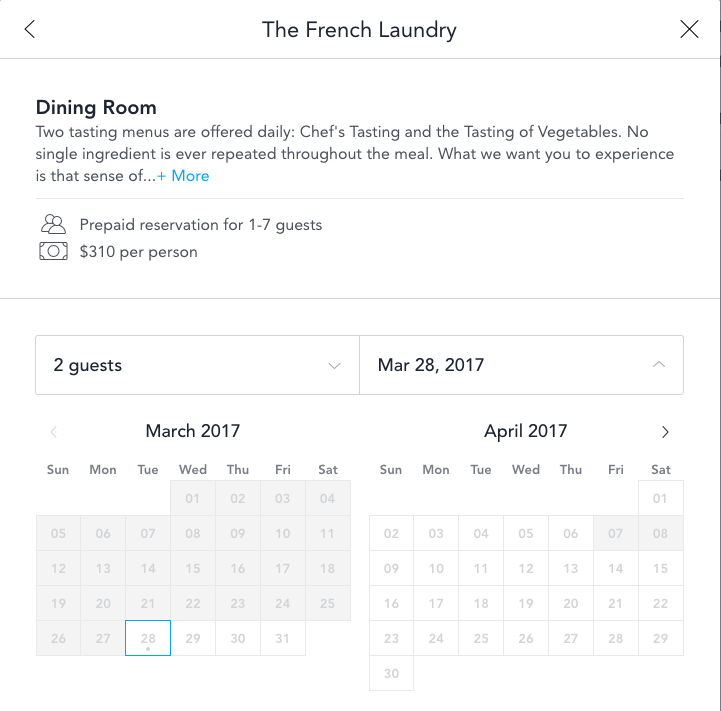
Here's an example (taken today) of the Tocktix interface.

Initially, I think I accidentally tried to make a reservation on March 27 because I actually thought it was just the opening of the calendar month window interface. What I didn't see was that this was further down the screen.
Instead, when I clicked the date, the calendar interface was gone. Same result, sort of, but up until this point, I thought I was making progress. So I clicked on "Add Me to the Wait List."


It was at this moment that I realized that things were unfolding badly for me. I went ahead and added my name to the wait list. At the same time, I was extremely frustrated that I couldn't add anything, no notes or comments, to clarify that this wasn't just any day, that it was my wife's birthday. Sure, I could add us to a wait list a week later, but that day wouldn't be anywhere nearly as important as the first day that I signed up for.

Since that time, I've also realized that there are other issues with the TockTix waiting line system.
  1. I can't tell what position in line that I am.
  2. I can't drop my listing from the wait list, like if say, we decided to cancel the entire trip to Yountville and go somewhere else.
  3. I get no sense of movement or updates from the list. I don't even get an initial confirmation email confirming my place in line. What if all of the other "people" in front of me are ticketing bots?
Needless to say, I my frustration with the entire experience hasn't dissipated.

Prospective Customers and The French Laundry
As a business, The French Laundry doesn't have to care about potential customers in the queue in the same way that some businesses do. As long as they have limited seats and a consistent parade of butts in the seats, and as long as they deliver a premium, desirable experience to them, they don't really need to care about the people in line. If I get frustrated or you get frustrated, who cares. It won't stop the guy behind you from happily filling a seat, given the opportunity. And maybe you're so frustrated that you write a review on Yelp, but you haven't even been there, so your complaints are hollow. In short, even if you say, "they suck," it's pretty unlikely that you're voice will be heard over the din of oohs and ahs from people who have been there. In the end, it doesn't matter. The French Laundry brand will transcend your unhappiness. They don't need you.

For me, this whole experience diminished the brand. Ultimately, that won't matter to you, the next guy in line, or probably anyone considering going to the restaurant.

And so you're probably thinking that, if they called me today and said, we've got a table for you and your wife, I would change my tune. To that, I'd say, you're probably right about going -- we still haven't canceled all of our Yountville plans yet. And at the same time, The French Laundry brand will never hold the same elevated benchmark status for me as it once did. And I think it's unlikely that I ever will go there. I certainly won't pursue reservations or try to get into the line again.

Tuesday, January 10, 2017

The Getty Images Extortion Letter

So I'm still annoyed about the whole thing with Getty Images. So I happened to do a quick search on "Getty Images Licensing Compliance" and came up with a number of posts addressing "the Getty Images Extortion Letter".

This article, How to Respond to the Getty Images Extortion Letter, is great. It's from the Art Law Journal. It provides a comprehensive explanation of what's going on as well as a template letter for your response. 

Here's another post from a hacker/security site with a more extensive cataloging of Getty Images extortion racket.

My takeaway?
I'm not going use Getty Images any longer and I recommend you avoid using them as well.